Cable tray installation is an important part of electrical infrastructure in industrial, commercial, infrastructure, warehouse, and utility projects across Saudi Arabia. A correctly installed cable tray provides a stable pathway for electrical cables, keeps cable routes organised, improves maintenance access, and supports future electrical expansion.
The quality of the installation depends on more than fixing a tray to a wall or ceiling. Contractors need to coordinate the cable route with the building structure, electrical equipment, mechanical services, fire protection systems, access areas, and other construction activities.
Saudi Arabia also presents different environmental conditions. An indoor electrical room in Riyadh has different requirements from an outdoor industrial installation in Jubail or Dammam. High temperatures, dust, humidity, salt exposure, and industrial operating conditions can all influence the selection and installation of the cable tray system.
What Is Cable Tray Installation?
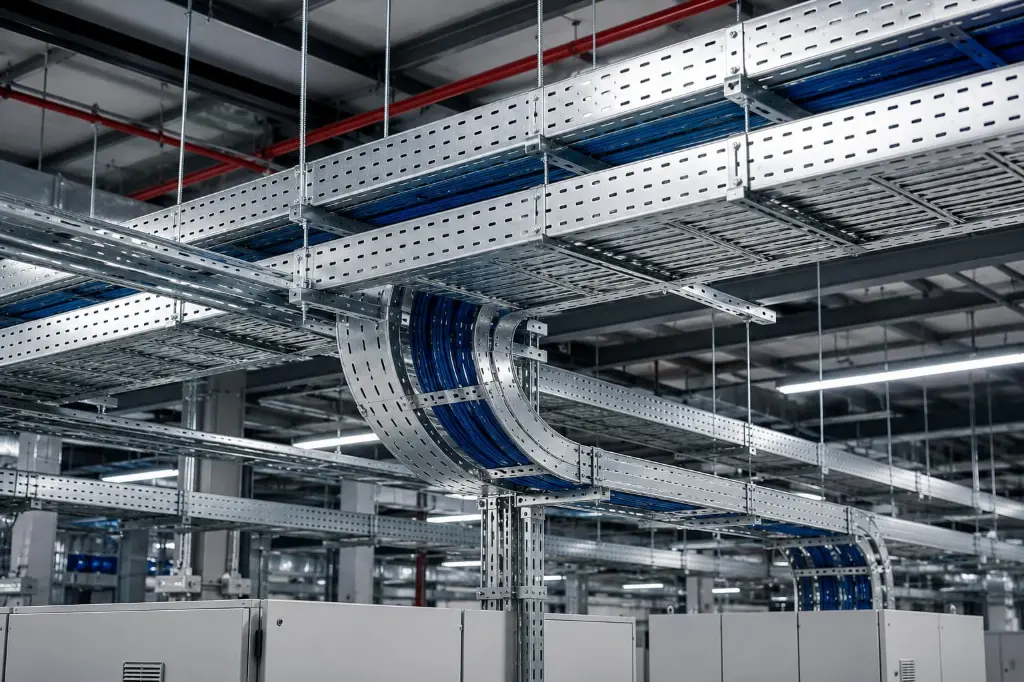
Cable tray installation involves assembling and securing cable tray sections and their accessories to create a continuous route for electrical and communication cables. The installation can include ladder cable trays, perforated cable trays, wire mesh cable trays, and their associated bends, tees, crosses, reducers, couplers, supports, brackets, covers, and cable fixing systems.
The tray must remain structurally stable while providing enough space for the intended cables. Before installation begins, the contractor should review the approved drawings, cable schedule, tray specifications, support details, and site conditions.
Why Proper Cable Tray Installation Matters
A cable tray may meet the correct specification but still perform poorly if the installation does not follow the design. Incorrect support spacing can cause excessive deflection. Poor alignment can create problems when cables are pulled through the route.
Insufficient clearance can make maintenance difficult. Improper connections can affect mechanical stability and electrical continuity where required. Good installation practices help the tray system perform as intended throughout the facility's operational life.
Cable Tray Installation Planning
Planning should take place before the contractor starts fixing tray supports. The team should review the complete route and identify changes in direction, elevation changes, equipment connections, cable entry points, and areas where multiple services cross. The tray route should also be coordinated with structural elements.
For industrial projects, early coordination is particularly important because cable routes may pass around large equipment, process lines, ventilation systems, fire protection infrastructure, and access pathways. A coordinated route reduces field modifications and avoids unnecessary installation delays.
Review the Cable Schedule First
The cable schedule provides important information for tray selection and installation. The contractor should understand the number of cables, cable sizes, cable types, approximate cable weights, and destination of each route.
A route carrying large power cables requires a different approach from a route carrying communication or control cables. The cable schedule also helps determine the required tray width and available spare capacity. Installing the tray before confirming these requirements can result in insufficient space or unnecessary material.
Selecting the Correct Cable Tray
The tray type should match the cable application. Ladder cable trays are commonly used for heavy power cable routes because their open construction provides strong support and good ventilation. Perforated cable trays provide a more continuous supporting surface and can accommodate many electrical applications.
Wire mesh cable trays offer flexibility and easy access and are commonly considered for communication, data, control, and lighter cable installations. The selection should depend on cable load, environment, support arrangement, project requirements, and future expansion.
Cable Tray Route Coordination
Cable trays rarely occupy an isolated space. They may share corridors and service areas with pipes, ducts, fire protection systems, lighting, structural elements, and other electrical services. The contractor should coordinate the tray route before installation. Maintaining adequate access around the tray is important because technicians may need to inspect, modify, or replace cables later.
A route that appears practical during construction can become difficult to maintain if other services are installed too close to it.
Cable Tray Support Installation
Supports carry the weight of the tray and the cables installed inside it. The support system may use wall brackets, trapeze supports, suspended supports, channels, or other structural arrangements.
The selected support should have sufficient capacity for the expected load. Support spacing should follow the approved design and manufacturer's technical information. The support structure should also be securely fixed to the building or structural framework. Installing supports without considering the final cable load can create structural problems after cable installation.
Support Spacing
Support spacing is one of the most important installation considerations. When the distance between supports becomes too large, the tray can deflect under load. The correct spacing depends on the tray design, material thickness, cable load, span requirements, and manufacturer recommendations.
Heavy duty tray systems may require different support arrangements from lightweight communication tray systems. Contractors should therefore avoid using a standard support distance for every tray type. The project specification and technical data should determine the final spacing.
Installing Cable Tray Bends
Bends allow the cable route to change direction. Horizontal bends change the direction of the route across the same elevation. Vertical bends allow the tray to move between different elevations. The bend should provide sufficient space for the cables to follow the route without exceeding their permitted bending radius.
This is particularly important for large power cables. Before installation, the contractor should confirm the required cable bending radius and coordinate the tray geometry accordingly.
Installing Cable Tray Tees and Crosses
Tees and crosses create branches within a cable tray network. A tee may connect a main route to a branch serving another section of the facility. A cross can connect several routes at a common point.
These fittings should match the tray dimensions and remain properly aligned with the connected sections. Using factory manufactured fittings can reduce field cutting and help maintain installation consistency.
Installing Cable Tray Reducers
Reducers connect tray sections with different widths. A wide main route may carry many cables while a smaller branch requires less space. The reducer should provide a smooth transition without creating unnecessary cable congestion.
Before installing the reducer, the contractor should confirm that the smaller tray has enough capacity for the cables entering the branch.
Connecting Cable Tray Sections
Couplers connect individual tray sections. The connection should maintain alignment and mechanical continuity between adjacent sections. Connection hardware should match the tray material and protective finish.
For galvanized systems, compatible connection components help maintain the intended corrosion protection. The contractor should also check that connections remain secure after the complete cable load is installed.
Cable Tray Installation Height
The installation height depends on the building layout and project design. Industrial facilities may install trays at elevated levels to keep them away from equipment and operational areas.
Commercial buildings may use ceiling spaces or dedicated service zones. The selected height should provide sufficient clearance from other services and maintain reasonable access for maintenance. The contractor should also consider equipment access, walkways, doors, maintenance platforms, and future building modifications.
Cable Tray Clearance
Adequate clearance is essential for safe installation and maintenance. The tray should not obstruct access routes, equipment doors, maintenance areas, ventilation systems, or fire protection equipment.
The contractor should also consider the space required for cable installation.A tray installed too close to a wall or another service can make cable pulling and future modifications difficult. Clearance requirements should follow the project drawings and applicable requirements.
Cable Arrangement Inside the Tray
Cable arrangement affects both accessibility and thermal performance. Power cables should be arranged according to the electrical design and cable manufacturer's recommendations.
Control, instrumentation, communication, and power cables may require separation depending on the project. Avoiding unnecessary cable congestion makes maintenance easier. The contractor should also maintain the required spare capacity where the design includes provision for future cables.
Cable Fixing and Cleats
Large cables may require suitable fixing systems. Cable cleats can help maintain cable position and control movement. The correct fixing system depends on cable diameter, installation arrangement, and electrical requirements.
For power installations, engineers may need to consider forces generated during electrical fault conditions. The cable fixing system should therefore be selected as part of the overall electrical design rather than as an afterthought during installation.
Cable Tray Earthing and Bonding
Metallic cable trays may form part of the electrical bonding and earthing arrangement when designed for this purpose. The project electrical design should define how the tray system will achieve the required electrical continuity. Connections between tray sections should provide the required continuity where applicable.
Additional bonding conductors may be required depending on the project design and applicable standards. Contractors should follow the approved electrical drawings instead of assuming that every mechanical tray connection automatically provides the required earthing path.
Galvanized Cable Tray Installation
Galvanized cable trays are widely considered for outdoor and industrial applications where corrosion protection is important. During installation, contractors should take care to avoid unnecessary damage to the protective coating.
Cutting, drilling, or other site modifications can expose the underlying steel. Where damage occurs, the affected area should be treated using an appropriate repair method according to the project specification. The same principle applies to galvanized fittings, brackets, supports, and other components. Maintaining the protective system across the complete installation helps improve long term corrosion performance.
Cable Tray Installation in Riyadh
Riyadh projects can experience high temperatures, dust, and strong sunlight, particularly for outdoor installations. The contractor should consider these conditions when selecting the tray material and protective finish.
Dust can also affect surrounding electrical equipment, so cable routes should be coordinated with equipment rooms and maintenance areas. Indoor and outdoor installations should not automatically use identical specifications. The installation environment should determine the final requirements.
Cable Tray Installation in Jeddah and Coastal Areas
Coastal locations such as Jeddah, Dammam, Jubail, and Yanbu require particular attention to corrosion protection. Humidity and salt exposure can increase corrosion risks for exposed steel. The contractor should handle galvanized components carefully and ensure that protective coatings remain in suitable condition.
Outdoor cable tray installations should also be inspected periodically after commissioning. The material and coating should be selected according to the environmental conditions identified during project design.
Cable Tray Installation for Industrial Facilities
Industrial installations often involve complex routes. Trays may pass around machinery, process equipment, control rooms, electrical rooms, and utility areas. The installation team should coordinate these routes with other construction disciplines.
Industrial environments may also contain heat, moisture, chemicals, dust, or vibration. The tray support system and protective finish should reflect the operating environment. A practical installation should provide enough access for maintenance teams without interfering with plant operations.
Cable Tray Installation for Data Centres
Data centres require organised cable routes with good accessibility. Communication and data cables may need frequent additions or changes as the facility expands. Wire mesh cable trays can provide flexible support and easy access for many data and communication applications.
Installation teams should coordinate the tray route with racks, cabinets, cooling systems, power infrastructure, and other services. Maintaining clear routes can simplify future cable management.
Cable Tray Installation for Warehouses
Warehouses can contain lighting, automation, conveyors, security systems, communication networks, charging systems, and other electrical infrastructure. Cable routes should remain clear of storage and operational areas.
The tray installation should be coordinated with warehouse racking, fire protection systems, ventilation, and equipment. For large warehouses, planning future expansion can also help avoid major modifications later.
Cable Tray Installation for Outdoor Projects
Outdoor cable tray installations require additional attention to environmental exposure. The material and coating should suit the site conditions. Supports should also withstand the environmental loads specified by the project.
The contractor should prevent water from becoming trapped in locations where the tray design does not provide suitable drainage. Covers may be required in some areas to protect cables from falling objects, debris, or direct environmental exposure.
The project design should determine whether covers are appropriate because they can also influence cable heat dissipation.
Common Cable Tray Installation Mistakes
One common mistake is installing the tray before coordinating the route with other services. Another is using excessive support spans without checking the tray manufacturer's technical information. Contractors can also create problems by cutting too many tray sections on site instead of using appropriate fittings.
Insufficient clearance can make future maintenance difficult. Damaging protective coatings during installation can also increase corrosion risk. These problems can usually be reduced through proper planning, accurate drawings, suitable accessories, and experienced installation teams.
Cable Tray Installation Quality Inspection
Inspection should take place during installation rather than only after the work is complete. The project team should check tray alignment, support spacing, connections, material condition, protective coating, clearance, route coordination, and accessory installation.
The completed route should also be checked against the approved drawings. Any damaged components should be identified before cables are installed. Early inspection makes corrections easier and reduces the possibility of expensive rework.
Cable Tray Installation Checklist
Before cable installation begins, the contractor should confirm that the tray route matches the approved design. The support system should be securely installed and properly spaced. Tray sections and fittings should be correctly connected.
The tray should have adequate capacity for the planned cables. Required separation and cable fixing arrangements should be confirmed. Protective coatings should be inspected for damage. The route should remain accessible for maintenance. These checks help ensure that the cable tray system is ready for the next stage of electrical installation.
Cost of Cable Tray Installation in Saudi Arabia
Cable tray installation cost varies from project to project. The final cost can depend on tray type, dimensions, material, coating, route length, support arrangement, installation height, number of fittings, cable load, site conditions, labour requirements, and project complexity.
A simple indoor route will have different installation requirements from a large outdoor industrial system. For accurate budgeting, project teams should evaluate both material and installation requirements. Comparing only the price per metre does not provide a complete picture of the project cost.
How to Choose a Cable Tray Installation Contractor
The installation contractor should have experience with the type of cable tray being used. For industrial projects, experience with heavy duty cable trays, galvanized systems, complex fittings, support structures, and large cable routes can be valuable.
The contractor should understand approved drawings, cable schedules, installation requirements, safety procedures, and quality inspection processes. Good communication between the contractor, consultant, electrical engineer, and cable tray supplier can reduce installation problems.
Hitech Cable Tray Solutions for Saudi Projects
Hitech can support cable management requirements by considering the complete system from tray selection through accessories and application requirements. Different areas of a project may require different tray configurations.
Heavy power routes may require ladder systems, while control and electrical routes may use perforated trays. Communication and data installations may benefit from wire mesh systems. The tray type, material, coating, dimensions, support arrangement, and accessories should all work together. This approach helps contractors and project teams develop a cable management system that matches the actual requirements of the facility.
Final Thoughts
Proper cable tray installation provides the foundation for an organised and maintainable electrical cable management system. The process starts with the cable schedule and approved route and continues through tray selection, support installation, fitting connections, cable arrangement, bonding, inspection, and final quality checks. Saudi Arabia's environmental conditions also require careful consideration.
Riyadh projects may need to account for heat and dust, while coastal locations such as Jeddah, Dammam, Jubail, and Yanbu require greater attention to corrosion protection.
Industrial facilities may introduce additional exposure to heat, moisture, chemicals, and mechanical activity. The most reliable installation approach is to coordinate the complete cable management system before work begins.
When the tray, supports, accessories, cable fixing systems, environmental protection, and installation route are properly coordinated, the finished system can provide reliable support, easier maintenance, and better long term value for Saudi electrical projects.