Galvanized cable trays provide a durable cable management solution for electrical, industrial, commercial, and infrastructure projects across Saudi Arabia. The zinc protective coating helps protect steel from corrosion, making galvanized cable trays suitable for many installations exposed to moisture, dust, humidity, and demanding operating conditions.
Cable tray systems support power, control, instrumentation, communication, and data cables while keeping electrical installations organised and accessible. However, the performance of the system depends heavily on selecting the right material and protective finish for the environment.
Saudi Arabia presents different environmental conditions across its regions. Inland projects can experience extreme heat and dust, while coastal areas such as Jeddah, Dammam, Jubail, and Yanbu face higher humidity and salt exposure. Industrial facilities may also expose cable support systems to chemicals, moisture, and other corrosive conditions.
For this reason, galvanized cable trays are an important option for many Saudi projects.
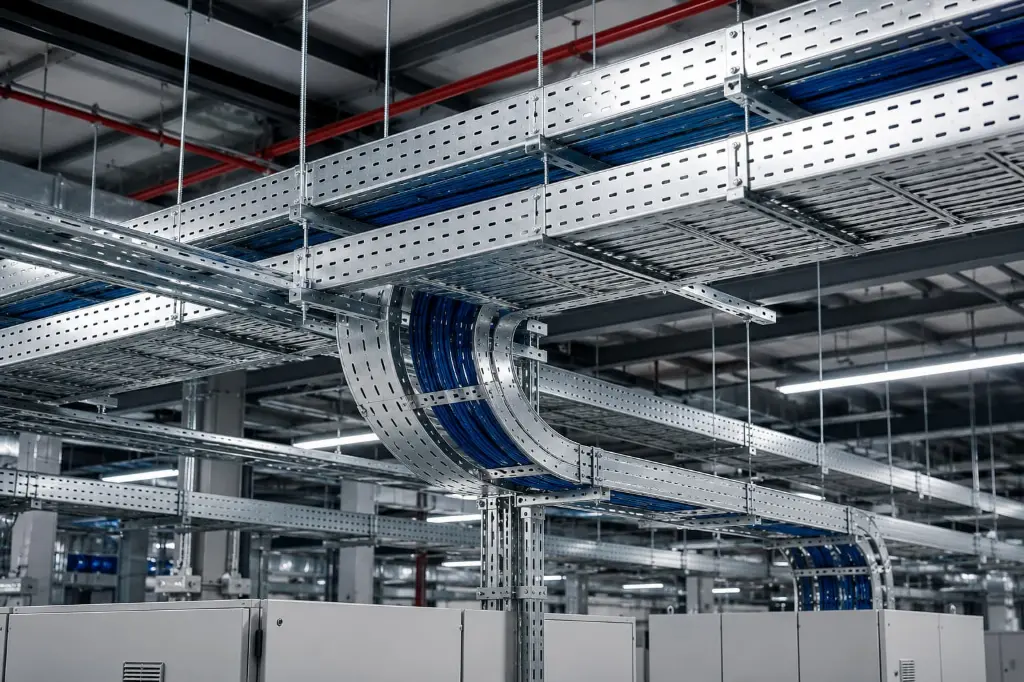
What Is a Galvanized Cable Tray?
A galvanized cable tray is a steel cable support system protected with a zinc coating to improve resistance against corrosion.
The tray can use different structural designs, including perforated, ladder, and wire mesh configurations.
Galvanization protects the underlying steel by creating a barrier between the steel surface and the surrounding environment. Zinc also provides additional protection when small areas of the surface become exposed.
The result is a cable support system designed to provide longer service life than unprotected steel in suitable environments.
Why Galvanized Cable Trays Are Important in Saudi Arabia
Cable trays installed outdoors or in demanding industrial environments can remain exposed for many years.
Corrosion can weaken steel components, affect connections, damage the appearance of the installation, and eventually compromise structural performance. Galvanizing provides a protective layer that helps reduce these risks.
For Saudi projects, the decision to use galvanized cable trays should consider the actual environment rather than relying on a standard specification for every location. An indoor electrical room in Riyadh may have different requirements from an outdoor installation in Jubail.
Understanding this difference helps project teams select the appropriate cable tray system.
How Does Galvanization Protect Steel?
Galvanization applies a protective zinc layer to steel. The zinc coating acts as a physical barrier between the steel and the surrounding environment. Zinc can also provide sacrificial protection to exposed steel in certain circumstances. This combination helps slow corrosion and protect the structural steel underneath. The quality and thickness of the coating affect the level of protection provided.
Project teams should therefore review the required galvanizing specification when purchasing cable trays rather than treating every galvanized product as technically equivalent.
Hot Dip Galvanized Cable Tray
Hot dip galvanizing is a widely recognised method of protecting steel products against corrosion. During the process, prepared steel is immersed in molten zinc. The zinc bonds with the steel surface and forms a protective coating. This process can provide durable corrosion protection for steel cable trays and their components.
Hot dip galvanized cable trays are particularly useful for outdoor and industrial applications where exposure to moisture and corrosive conditions is expected. The required coating should match the project's environmental and technical requirements.
Galvanized Perforated Cable Tray
Perforated cable trays have a continuous supporting surface with openings in the base and side sections. When galvanized, they combine continuous cable support with corrosion protection.
They can be suitable for power, control, instrumentation, and other electrical cable applications depending on the project design.
Galvanized perforated trays are commonly considered for industrial buildings, outdoor routes, electrical rooms, commercial facilities, and infrastructure projects.
The tray thickness, width, load capacity, and coating specification should be selected according to the cable installation.
Galvanized Ladder Cable Tray
Ladder cable trays consist of two side rails connected by cross rungs.Their open construction provides excellent ventilation and convenient cable fixing points. Galvanized ladder cable trays can be particularly useful for heavy power cable routes and industrial installations exposed to demanding conditions.
The open design also makes inspection and maintenance easier. For heavy duty applications, engineers should evaluate cable weight, support span, tray dimensions, material thickness, and environmental exposure before selecting the final specification.
Galvanized Wire Mesh Cable Tray
Wire mesh cable trays use welded steel wires to create an open mesh structure. Galvanized wire mesh trays can provide corrosion protection while maintaining the flexibility and ventilation advantages of the mesh design.
They are often considered for communication, control, data, fibre optic, and lighter electrical cables. The open structure allows technicians to access cables easily and make future routing changes. For outdoor applications, the coating specification should match the expected environmental exposure.
Galvanized Cable Tray for Coastal Saudi Arabia
Coastal environments require particular attention to corrosion protection. Locations such as Jeddah, Dammam, Jubail, and Yanbu can expose steel infrastructure to humid and salt laden air. Salt can accelerate corrosion of unprotected steel, especially where moisture remains on the surface.
Galvanized cable trays can provide useful protection in these conditions when the coating is appropriately specified. However, coastal exposure varies by location and installation. Project teams should evaluate the actual environment and follow the required corrosion protection specification.
Galvanized Cable Tray for Riyadh
Riyadh presents a different environmental profile. Outdoor installations can experience high temperatures, intense sunlight, dust, and dry conditions. While moisture exposure may be lower than in coastal areas, cable tray systems still require suitable protection and durable construction.
Galvanized cable trays can be appropriate for many outdoor and industrial applications in Riyadh. The final specification should consider the location, installation conditions, cable load, and project requirements.
Galvanized Cable Tray for Industrial Facilities
Industrial plants can expose cable trays to more demanding conditions than typical commercial buildings. Manufacturing operations may involve heat, moisture, chemicals, dust, vibration, and continuous equipment operation.
Cable trays may also carry large numbers of power and control cables. For these installations, project teams should evaluate both structural performance and corrosion resistance.
Galvanized steel can provide a practical combination of strength and corrosion protection for many industrial applications. Where the environment is highly aggressive, engineers may need to consider enhanced coating systems or alternative materials.
Galvanized Cable Tray for Power and Utility Projects
Power and utility facilities depend on reliable electrical infrastructure. Cable trays may support power distribution cables, control cables, instrumentation, and communication systems.
Outdoor substations and utility areas can expose cable support systems to weather and environmental conditions. Galvanized cable trays can provide corrosion protection while maintaining the structural strength required for many electrical installations.
The tray design should be selected according to the cable load, support arrangement, environmental exposure, and applicable project specifications.
Galvanized Cable Tray for Warehouses
Warehouses increasingly use electrical systems for lighting, automation, security, material handling, and communication. Cable trays provide organised routes for these systems.
Where trays are installed outdoors or in partially exposed areas, galvanized steel can provide additional corrosion protection. The tray system should also be coordinated with storage racks, equipment, fire protection systems, and maintenance pathways. Proper planning helps prevent cable routes from interfering with warehouse operations.
Galvanized Cable Tray vs Stainless Steel Cable Tray
Both galvanized steel and stainless steel can provide corrosion resistance, but they are not interchangeable in every application. Galvanized steel generally offers a practical balance between structural strength, corrosion protection, and cost.
Stainless steel can provide greater corrosion resistance in highly aggressive environments, but it typically comes with a higher material cost. The correct choice depends on the environmental conditions and project requirements.
Using stainless steel where it is not necessary can increase project cost, while selecting an insufficient coating for a highly corrosive environment can create long term maintenance problems.
Galvanized Cable Tray vs Powder Coated Cable Tray
Powder coating provides a finished protective surface and is often used for indoor applications. Galvanization provides zinc based corrosion protection and is widely considered for outdoor and industrial steel applications. The two systems serve different requirements. In some applications, a combination of galvanizing and an additional coating system may be considered when enhanced protection is required. The correct solution should depend on environmental exposure and the project's technical specification.
Cable Tray Coating Thickness
Coating thickness is an important factor when evaluating galvanized cable trays. A thicker or more appropriate coating can provide greater protection, but the required specification depends on the product, galvanizing method, environment, and applicable standard.
Project teams should obtain coating information from the manufacturer and ensure that it meets the approved specification. A supplier should be able to provide technical documentation supporting the proposed coating system.
Cable Tray Load Capacity
Corrosion protection is only one part of cable tray selection. The tray must also support the required cable load. Engineers should consider cable weight, tray width, material thickness, support spacing, span length, cable arrangement, and future expansion.
A galvanized tray with inadequate structural capacity will not provide a suitable solution simply because it has good corrosion resistance. The structural and environmental requirements should therefore be evaluated together.
Cable Tray Size and Dimensions
Cable tray dimensions should be based on the actual cable schedule. The required width depends on the number and size of cables. The depth should provide adequate space for the intended cable arrangement. Material thickness should reflect the expected load and support span. Future expansion should also be considered. Leaving suitable spare capacity can make it easier to add cables later without replacing the complete cable support system.
Galvanized Cable Tray Accessories
A complete cable tray system requires compatible fittings and supports. Depending on the route, a project may require bends, tees, crosses, reducers, couplers, covers, brackets, supports, clamps, and other accessories. Accessories should have appropriate corrosion protection to maintain the performance of the complete system.
Using unprotected accessories with a galvanized tray can create weak points within the installation. For this reason, project teams should evaluate the complete system rather than purchasing tray sections separately from unrelated accessories.
Galvanized Cable Tray Installation
Proper installation protects the performance of the galvanized system. Before installation, contractors should confirm cable routes, support positions, tray dimensions, elevations, and equipment interfaces. Tray sections should be aligned and securely connected.
Cutting or drilling galvanized components on site can expose steel surfaces. Any damaged areas should be treated using an appropriate repair method according to the project requirements. Installers should also avoid unnecessary damage to the protective coating during transportation and handling.
Earthing and Electrical Continuity
Metallic cable tray systems can form part of the electrical bonding and earthing arrangement when designed and installed accordingly. The project electrical design should define the required bonding and earthing approach.
Connections between tray sections should provide the required electrical continuity where applicable. Additional bonding conductors may be required depending on the design and applicable standards. The installation should therefore be reviewed by the responsible electrical engineer rather than assuming that every tray connection automatically provides the required earthing path.
Maintenance of Galvanized Cable Trays
One of the advantages of galvanized cable trays is reduced corrosion maintenance in suitable environments. However, galvanized does not mean maintenance free.
Project teams should periodically inspect outdoor and industrial installations for physical damage, corrosion, loose connections, excessive cable loading, and support problems. Particular attention should be given to areas where the coating may have been damaged during installation. Early identification of problems can prevent more expensive repairs later.
Common Mistakes When Selecting Galvanized Cable Tray
A common mistake is choosing a galvanized tray without checking the coating specification. Another is selecting the tray based only on width while ignoring cable weight and support span. Some projects also focus heavily on the initial price and overlook the cost of maintenance and replacement. Using accessories with inadequate corrosion protection can also reduce the effectiveness of the complete system.
These problems can be avoided by reviewing the environmental conditions, cable schedule, structural requirements, coating specification, and complete accessory package before procurement.
How Much Does a Galvanized Cable Tray Cost in Saudi Arabia?
The price of a galvanized cable tray depends on its technical specification. Material thickness, tray type, width, depth, coating, quantity, accessories, supports, transportation, and installation can all affect the final project cost. A heavy duty galvanized ladder tray will have different pricing from a lightweight wire mesh tray.
For accurate pricing, suppliers should receive the project drawings, cable schedule, required dimensions, coating requirements, quantities, and accessories list. Comparing prices without comparing technical specifications can lead to an inaccurate purchasing decision.
How to Choose a Galvanized Cable Tray Supplier in Saudi Arabia
A reliable supplier should provide clear technical information about the cable tray system. Project teams should evaluate manufacturing capability, steel quality, material thickness, galvanizing process, coating specification, product range, accessories, technical documentation, production capacity, and delivery capability.
Experience with Saudi projects can also help suppliers understand the environmental and installation challenges associated with different regions. For large industrial and infrastructure projects, local technical support and reliable delivery can be just as important as the product itself.
Why Hitech Cable Tray Solutions Can Be Considered
For Saudi industrial and infrastructure projects, cable management should be selected according to the actual installation environment. Hitech can support project requirements by considering the cable application, tray configuration, dimensions, structural requirements, environmental exposure, and protective finish.
Different areas of the same project may require different tray configurations. For example, a project may use galvanized ladder trays for heavy power cables, galvanized perforated trays for control systems, and wire mesh trays for communication cables. Selecting each system according to its application can provide better technical performance and avoid unnecessary material costs.
Final Thoughts
Galvanized cable trays provide a practical combination of structural strength and corrosion protection for many electrical installations in Saudi Arabia. They can support power, control, instrumentation, communication, and other suitable cable systems across industrial, commercial, utility, warehouse, and infrastructure projects.
The main advantage of galvanization is protection against corrosion, but selecting the correct tray requires more than choosing a galvanized finish. Engineers should consider cable load, tray dimensions, material thickness, coating specification, support spacing, installation environment, and future expansion.
Coastal projects in Jeddah, Dammam, Jubail, and Yanbu require particular attention to corrosion, while inland projects such as Riyadh must consider high temperatures, dust, and outdoor exposure.
The most effective approach is to select the complete cable tray system according to the project's technical and environmental requirements.
When the correct tray design, material, coating, accessories, and installation method work together, a cable management system can provide reliable performance and easier maintenance throughout the facility's service life.