Ladder cable trays provide a strong and practical method for supporting electrical cables in industrial, commercial, power, and infrastructure projects across Saudi Arabia. Their open ladder design provides excellent ventilation, easy cable access, and strong support for installations carrying substantial cable loads.
Large facilities often require extensive cable networks for power distribution, control systems, instrumentation, automation, and communications. Without a properly designed cable support system, cables can become difficult to organise, inspect, and maintain.
Saudi Arabia's demanding climate also makes material selection important. High temperatures, dust, humidity, and coastal salt exposure can affect exposed steel infrastructure. Selecting the correct ladder cable tray, protective coating, support system, and installation method can therefore have a significant effect on long term performance.
This guide explains ladder cable trays, their applications, technical considerations, advantages, installation requirements, and how to select the right system for projects in Saudi Arabia.
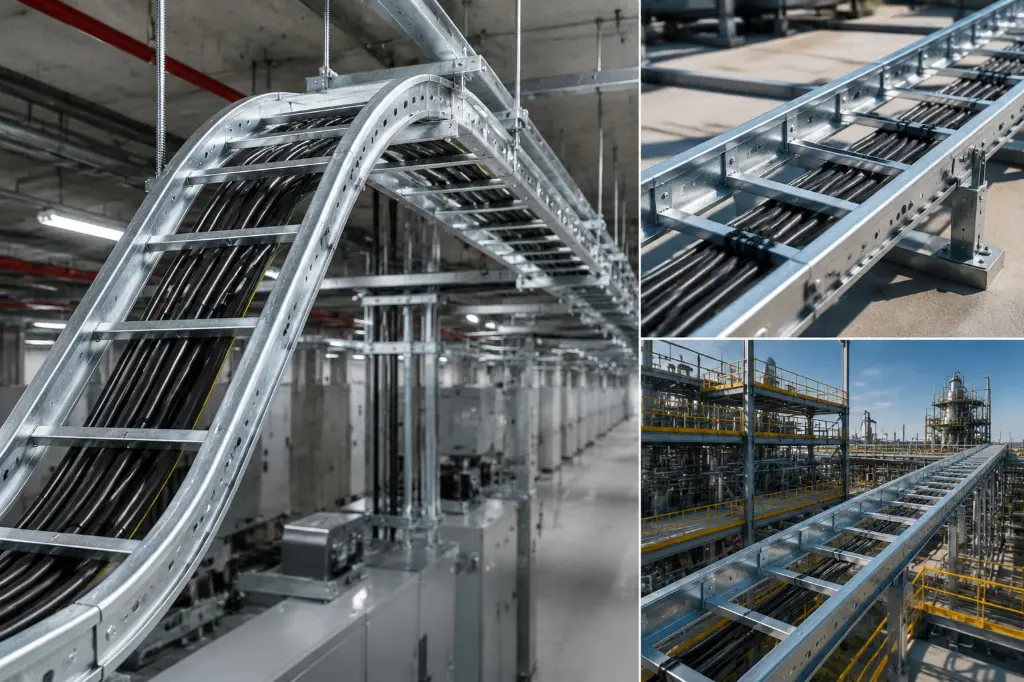
What Is a Ladder Cable Tray?
A ladder cable tray is a cable support system consisting of two longitudinal side rails connected by regularly spaced cross members called rungs.
The open structure creates a strong support pathway while allowing air to circulate around the cables.
The rungs also provide convenient points for securing cables with suitable clamps, cleats, ties, and other accessories.
This design makes ladder cable trays particularly suitable for power cables and industrial installations where cable weight, ventilation, and maintenance access are important.
Ladder trays are available in different widths, depths, material thicknesses, and finishes to accommodate different project requirements.
Why Use a Ladder Cable Tray?
The design of a ladder cable tray provides several practical advantages. The open structure allows air to circulate around cables, which can help manage heat generated during electrical operation. Technicians can also access cables easily from above and below the tray in many installations. The rungs provide convenient fixing points for cable cleats and supports, helping keep cables organised along the route. For industrial projects carrying large numbers of power cables, these characteristics can make ladder cable trays a highly practical cable management solution.
Where Are Ladder Cable Trays Used?
Ladder cable trays are commonly considered for demanding electrical installations. Industrial plants, manufacturing facilities, power related projects, substations, warehouses, infrastructure developments, utility facilities, commercial buildings, and large construction projects may all require ladder cable tray systems. They are particularly useful where cables are heavy or where the installation requires significant ventilation. The final tray configuration should always follow the project's electrical design and cable schedule.
Ladder Cable Tray for Heavy Power Cables
Heavy power cables can place significant loads on cable support systems. Ladder cable trays provide strong longitudinal support while allowing cables to be secured at regular intervals. For large power installations, engineers should consider cable weight, tray dimensions, material thickness, support spacing, span length, and cable arrangement. The system should also account for the number of cables installed within each tray section. A tray designed for a small control cable installation may not be suitable for large power cables. Proper load calculations are therefore essential before selecting the tray specification.
Excellent Ventilation Around Cables
Heat management is an important consideration in electrical installations. Electrical cables generate heat during operation, and cable grouping can influence their ability to dissipate that heat. The open structure of ladder cable trays allows air to move freely around the cables. This makes ladder trays particularly useful for installations where ventilation is an important design consideration. However, tray selection does not replace proper electrical calculations. Cable sizing, grouping, spacing, ambient temperature, and installation conditions should all be evaluated by the project's electrical engineer.
Ladder Cable Tray in Saudi Arabia's Climate
Saudi Arabia's environmental conditions vary significantly by region. In Riyadh and other inland areas, high temperatures and dust can affect exposed infrastructure. Coastal areas such as Jeddah, Dammam, Jubail, and Yanbu experience higher humidity and salt exposure, which can increase corrosion risks. For outdoor installations, selecting an appropriate corrosion protection system is therefore essential. Galvanized steel is commonly considered for cable tray applications where protection against environmental exposure is required. The coating specification should match the project environment and technical requirements.
Galvanized Ladder Cable Tray
Galvanized ladder cable trays use a zinc protective coating to help protect steel from corrosion. This can make them suitable for many industrial and outdoor applications. The galvanizing process and coating specification are important factors in determining long term performance. Project teams should review the required coating standard rather than relying solely on the term galvanized. For demanding environments, the project specification may require a particular coating thickness or additional corrosion protection. A properly specified galvanized ladder cable tray can reduce maintenance requirements and extend the useful life of the cable support system.
Powder Coated Ladder Cable Tray
Powder coating provides a durable finished surface and can improve the appearance of exposed cable management systems. It also allows project teams to specify a particular colour where required. Powder coated trays can be suitable for indoor commercial and industrial applications where appearance is important. For outdoor or highly corrosive environments, however, the complete protection system should be evaluated carefully.The appropriate finish depends on exposure conditions, project specifications, and expected service life.
Ladder Cable Tray vs Perforated Cable Tray
Ladder and perforated cable trays serve different cable management requirements. A ladder tray provides an open structure with rungs between two side rails. This design provides excellent ventilation and convenient cable access. A perforated cable tray has a continuous supporting surface with openings in the base and sides. This provides more continuous support beneath the cables. Ladder trays are often preferred for heavy power cable installations where ventilation and cable accessibility are important. Perforated trays can be useful where cables require continuous support across the route. The correct selection should depend on the cable type, load, environmental conditions, and approved project design.
Ladder Cable Tray vs Wire Mesh Cable Tray
Wire mesh cable trays use welded steel wire to create an open mesh structure. They are commonly used for lighter electrical, communication, control, and data cables.Ladder cable trays generally provide greater structural capacity for heavy cable installations when appropriately specified. Wire mesh systems can provide flexibility and easy access for cable routing changes. For large industrial power installations, ladder cable trays are often more appropriate. For data and communication installations, wire mesh cable trays may offer practical advantages.
Contact Us
Optimize your cable infrastructure with Hitech ladder cable tray systems.
Contact our experts today
Ladder Cable Tray Dimensions
Tray dimensions should be selected according to the cable schedule. Important dimensions include tray width, depth, material thickness, and support span. The width must provide enough space for the required cables while allowing appropriate arrangement and future capacity. The depth should accommodate the cable arrangement without creating unnecessary congestion. For industrial projects, engineers should also consider future expansion because additional cables may be added after the facility becomes operational. Selecting a tray with appropriate spare capacity can make future modifications significantly easier.
Ladder Cable Tray Load Capacity
Load capacity is a critical consideration for heavy duty cable tray systems.
The total cable weight must be evaluated across the intended support span.
Engineers should consider:
- Cable weight
- Tray material and thickness
- Tray width and depth
- Support spacing
- Span length
- Cable arrangement
- Environmental loads
- Future cable additions
Manufacturers should provide technical information that allows engineers to evaluate the structural performance of the selected tray.
A heavy duty application should never rely on assumptions based only on tray appearance or dimensions.
Ladder Cable Tray Support Systems
The cable tray must be properly supported by the building or structural framework.
Depending on the installation, projects may use wall brackets, trapeze supports, suspended supports, channels, or other structural arrangements.
Support spacing should be determined according to the tray design, load, span, and manufacturer's recommendations.
Insufficient support can result in excessive deflection and may affect the long term performance of the system.
The support system should therefore be considered as part of the complete cable tray design.
Ladder Cable Tray Accessories
A complete ladder cable tray installation requires compatible accessories.
These may include bends, tees, crosses, reducers, couplers, covers, brackets, supports, clamps, and cable fixing components.
Accessories allow the tray route to follow the actual geometry of the building or industrial facility.
Using compatible components helps maintain structural continuity and simplifies installation.
For large projects, sourcing the tray and accessories from the same manufacturer can also reduce compatibility problems.
Cable Separation and Organisation
Large industrial facilities may contain different types of electrical and communication cables.
Depending on the project design, cables may need to be separated to reduce interference, simplify maintenance, or meet specific electrical requirements.
Ladder cable trays can accommodate organised cable arrangements using suitable cleats, clamps, and dividers where required.
The final arrangement should follow the project's approved electrical design.
Good cable organisation also makes future inspection and troubleshooting easier for maintenance teams.
Ladder Cable Tray Installation
Professional installation is essential for achieving reliable long term performance.
Before installation, contractors should verify the cable route, elevations, support positions, equipment interfaces, and access requirements.
Tray sections should be accurately aligned and securely connected.
The installation team should also inspect the protective coating for damage and repair affected areas using an appropriate method where required by the project specification.
Outdoor installations require additional attention to environmental exposure and drainage.
Proper installation makes cable pulling, inspection, maintenance, and future expansion easier.
Common Ladder Cable Tray Installation Mistakes
Several problems can reduce the performance of a cable tray system.
One common issue is selecting the tray before confirming the actual cable load.
Another is using excessive support spans without verifying the tray's structural capacity.
Poor coordination with other building services can also force unnecessary changes to cable routes.
Inadequate corrosion protection can become a long term problem for outdoor installations, particularly in coastal areas.
These issues can often be avoided by coordinating the electrical design, structural requirements, and cable tray supplier before installation begins.
Ladder Cable Tray for Industrial Facilities
Industrial plants often contain complex electrical infrastructure.
Power distribution systems, automation equipment, instrumentation, motors, control panels, and communication networks may all require organised cable routes.
Ladder cable trays can provide the structural capacity and ventilation required for many of these installations.
Large industrial projects may use multiple tray sizes and configurations throughout the facility.
For example, heavy power cables may require larger ladder trays, while smaller control cables may use perforated or wire mesh systems.
Using the right tray for each application can improve performance while avoiding unnecessary material costs.
Ladder Cable Tray for Power Plants and Utility Projects
Power and utility facilities place high demands on cable management infrastructure.
Cable systems may operate continuously and support critical equipment.
Ladder cable trays can provide reliable support for power and control cables when correctly designed and installed.
Engineers should pay particular attention to cable loading, support structures, environmental exposure, access requirements, and cable separation.
The tray route should also be coordinated with electrical equipment, maintenance pathways, and other infrastructure.
Ladder Cable Tray for Warehouses
Modern warehouses increasingly depend on electrical systems for lighting, automation, security, material handling, and communication.
Cable tray systems provide organised pathways throughout these facilities.
Ladder cable trays can be used where heavier power cables need strong support and good ventilation.
The system should be coordinated with warehouse racking, equipment routes, fire protection systems, and maintenance access.
Planning cable routes before the warehouse becomes operational can prevent difficult modifications later.
How Much Does a Ladder Cable Tray Cost in Saudi Arabia?
There is no single price for ladder cable tray because project requirements vary.
Cost can depend on material, tray width, depth, thickness, coating, quantity, accessories, support requirements, transportation, and installation.
A heavy duty galvanized tray for a large industrial project will have very different requirements from a smaller indoor installation.
When comparing quotations, buyers should ensure that all suppliers are offering equivalent technical specifications.
Comparing price alone can result in selecting a cheaper product with a different material thickness, coating, or load capacity.
A proper technical comparison should evaluate the complete system.
How to Choose a Ladder Cable Tray Supplier in Saudi Arabia
Project owners, consultants, and contractors should evaluate several factors before selecting a supplier.
Manufacturing capability, steel quality, material thickness, coating specification, product range, accessory availability, technical documentation, production capacity, and project experience should all be considered.
A supplier with experience in Saudi industrial projects can also provide useful guidance regarding environmental exposure and practical installation requirements.
For large projects, reliable delivery is equally important because cable tray installation often follows strict construction schedules.
A capable supplier should be able to support the project from technical selection through procurement and delivery.
Ladder Cable Tray Standards
The applicable standards depend on the project and its technical requirements.
IEC 61537 is an important international standard for cable tray and cable ladder systems.
However, engineers should also review the requirements specified by the project consultant, client, utility provider, authority, or applicable Saudi regulations.
The supplier should provide relevant technical documentation and certification where required.
Rather than relying on a generic compliance statement, project teams should confirm that the proposed tray meets the exact requirements specified for the installation.
Final Thoughts
Ladder cable trays provide an effective cable management solution for heavy power cables and demanding industrial installations across Saudi Arabia.
Their open structure provides strong cable support, excellent ventilation, convenient fixing points, and easy maintenance access.
However, selecting the correct system requires careful evaluation of cable weight, tray dimensions, material thickness, support spacing, environmental exposure, coating, and future capacity.
Saudi Arabia's climate makes corrosion protection particularly important for outdoor installations. Galvanized ladder cable trays can provide effective protection for many applications when the coating specification matches the environment.
For industrial and infrastructure projects, the best cable tray system is one that meets the project's technical requirements while providing reliable performance throughout its service life.
A properly designed ladder cable tray system can simplify installation, improve cable organisation, support easier maintenance, and provide the structural reliability required by modern Saudi industrial facilities.