Wire mesh cable trays provide a flexible and accessible solution for organising electrical, communication, control, and data cables. Their open structure offers excellent ventilation while making cable installation, inspection, and future modifications easier.
As Saudi Arabia continues to develop data centres, commercial buildings, industrial facilities, manufacturing plants, warehouses, and infrastructure projects, efficient cable management has become increasingly important. Modern facilities often contain large quantities of cables that need organised routes and reliable mechanical support.
Wire mesh cable trays can be particularly useful where projects require flexibility, ventilation, easy access, and efficient cable routing.
However, selecting the right system requires careful consideration of cable type, load capacity, mesh dimensions, material, corrosion protection, support spacing, and installation environment.
This guide explains wire mesh cable trays, their applications, advantages, limitations, materials, installation requirements, and selection considerations for projects in Saudi Arabia.
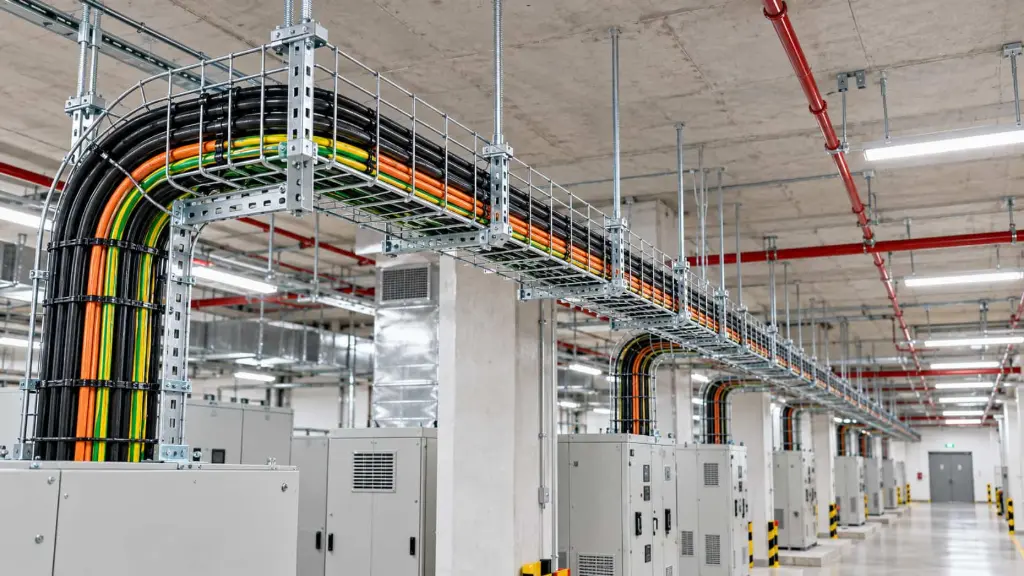
What Is a Wire Mesh Cable Tray?
A wire mesh cable tray is a cable support system manufactured from welded steel wires that form an open mesh structure.
The mesh provides continuous support while leaving large open areas around the cables. This allows air to circulate freely and provides convenient access for installation and maintenance.
The open structure also allows installers to route cables through the mesh at different points without making large modifications to the tray.
Wire mesh cable trays are available in different widths, heights, wire diameters, finishes, and configurations.
The appropriate specification depends on the application and the expected cable load.
Why Use a Wire Mesh Cable Tray?
Wire mesh cable trays offer several practical benefits.
Their open design provides excellent airflow around cables, which can be useful for communication and electrical installations where ventilation matters.
The mesh structure also makes the tray relatively easy to access during installation and maintenance.
Another advantage is flexibility. Technicians can make cable drops or changes at suitable locations without modifying a solid tray structure.
For facilities where cable routes may change over time, this flexibility can reduce installation effort during future upgrades.
Where Are Wire Mesh Cable Trays Used?
Wire mesh cable trays are suitable for many indoor and controlled industrial environments.
Common applications include data centres, server rooms, communication facilities, office buildings, commercial developments, industrial control systems, manufacturing facilities, and low voltage cable installations.
They can support data cables, fibre optic cables, control cables, instrumentation cables, and other suitable cable types.
For heavy power cable applications, engineers may select ladder or other heavy duty tray systems instead.
The final choice should always follow the electrical design and cable manufacturer's requirements.
Wire Mesh Cable Tray for Data Centres
Data centres require highly organised cable management because large numbers of communication and power cables can occupy limited spaces.
Wire mesh cable trays provide easy access to cables and allow technicians to modify routes as the data centre expands.
The open structure also promotes airflow around cables.
Data centre installations often require careful separation and routing of different cable types. The tray system should therefore be coordinated with racks, cabinets, containment systems, cooling infrastructure, and other services.
Planning for future expansion is particularly important because data centre cable requirements can increase significantly after initial commissioning.
Wire Mesh Cable Tray for Communication Cables
Communication systems depend on organised cable routing.
Network cables, fibre optic cables, control cables, and other low voltage systems can become difficult to manage when they are installed without a structured support system.
Wire mesh cable trays provide an accessible pathway that allows technicians to identify and manage cable routes efficiently.
The open design can also make cable additions easier when a facility needs to expand its communication infrastructure.
Wire Mesh Cable Tray for Industrial Facilities
Industrial facilities often contain extensive control and instrumentation networks.
Manufacturing plants may use cables for automation systems, sensors, control panels, monitoring equipment, communication networks, and other industrial systems.
Wire mesh cable trays can provide suitable support for many of these lighter cable applications.
However, industrial facilities can expose cable management systems to dust, moisture, chemicals, heat, and mechanical activity.
The selected material and coating should therefore reflect the actual operating environment.
Wire Mesh Cable Tray vs Ladder Cable Tray
Wire mesh and ladder cable trays are both open cable support systems, but their applications can differ.
Wire mesh trays use welded wires to create a mesh surface and are often selected for lighter cables, communication systems, data networks, and control installations.
Ladder trays use side rails and cross rungs and are commonly selected for heavier power cables and larger industrial cable routes.
Ladder trays generally provide greater structural capacity for heavy cable installations when appropriately designed.
Wire mesh trays provide excellent flexibility for cable routing and are particularly convenient where frequent cable changes are expected.
The correct option depends on the cable load, cable type, environment, and project requirements.
Wire Mesh Cable Tray vs Perforated Cable Tray
Perforated cable trays provide a more continuous supporting surface beneath the cables.
Wire mesh cable trays provide a much more open structure.
A perforated tray can be useful where cables require continuous support across the route.
A wire mesh tray can be advantageous where ventilation, flexibility, and easy access are priorities.
Neither option is universally better.
Engineers should consider cable size, cable weight, installation environment, support requirements, and future expansion before making the final selection.
Choosing the Right Wire Mesh Cable Tray Material
Material selection directly affects service life.
Steel is commonly used because it provides good structural strength and can support a wide range of cable applications.
The protective finish becomes especially important when the tray is exposed to moisture or corrosive conditions.
For many Saudi applications, galvanized steel can provide effective corrosion protection.
Stainless steel may be considered for highly corrosive environments where project requirements justify the additional cost.
The appropriate material should always reflect the installation environment and project specification.
Galvanized Wire Mesh Cable Tray
Galvanized wire mesh cable trays have a protective zinc coating that helps protect the steel from corrosion.
This makes them suitable for many industrial and outdoor applications.
Saudi Arabia's environmental conditions vary significantly by region. Inland facilities experience intense heat and dust, while coastal industrial areas can face higher humidity and salt exposure.
For projects near the coast, corrosion protection deserves particular attention.
The required galvanizing specification should be confirmed during procurement rather than relying solely on a generic galvanized product description.
Contact Us
Protect your assets with Hitech Fence’s . For consultations, demonstrations, or inquiries:
Powder Coated Wire Mesh Cable Tray
Powder coating can provide a smooth and durable finish to wire mesh cable trays.
It can also provide an aesthetic advantage where the tray remains visible within a commercial or industrial facility.
Powder coating is often considered for indoor environments where appearance and surface protection are important.
For outdoor and highly corrosive installations, the complete protection system should be evaluated according to the environmental conditions.
The coating should not be selected purely for appearance.
Wire Mesh Cable Tray Dimensions
Tray dimensions should correspond to the cable installation.
Important factors include tray width, tray height, wire diameter, mesh configuration, and support span.
The tray should provide sufficient space for the required cables without creating unnecessary congestion.
Engineers should also consider future cable additions.
A cable tray that is completely full immediately after installation can make future expansion difficult and may create maintenance problems.
Providing suitable spare capacity during the design stage can improve long term flexibility.
Wire Mesh Cable Tray Load Capacity
Load capacity must be considered before selecting the tray.
Although wire mesh trays are often used for lighter cable installations, the actual capacity depends on the tray construction, wire diameter, dimensions, support arrangement, and span.
Engineers should calculate the expected cable load and compare it with the manufacturer's technical information.
Support spacing also has a direct effect on structural performance.
A tray suitable for a short span may not provide the same performance when installed across a longer span.
Wire Mesh Cable Tray Accessories
A complete wire mesh cable tray system requires compatible accessories.
These can include couplers, bends, tees, crosses, reducers, brackets, supports, clamps, covers, and cable fixing components.
Accessories allow the tray route to follow the geometry of the building or industrial facility.
Using compatible components helps maintain a stable and organised installation.
For large projects, sourcing the tray and accessories from the same manufacturer can simplify procurement and reduce compatibility issues.
Cable Tray Support Systems
Wire mesh trays require suitable supports to maintain structural stability.
Depending on the building design, installations may use wall brackets, suspended supports, trapeze systems, channels, or other support structures.
Support spacing should be selected according to the tray design, cable load, span, and manufacturer's recommendations.
Insufficient support can cause excessive deflection.
Overly close support spacing can increase project cost without providing a meaningful technical advantage.
The support design should therefore form part of the overall cable tray engineering process.
Wire Mesh Cable Tray Installation
Professional installation helps ensure that the cable management system performs correctly throughout its service life.
Before installation begins, contractors should review cable routes, elevations, support positions, equipment interfaces, and access requirements.
Tray sections should be properly aligned and securely connected.
The installation team should also avoid damaging protective coatings during cutting, drilling, or modification.
Where coating damage occurs, the affected area should be treated using an appropriate repair method according to the project specification.
Cable Organisation in Wire Mesh Trays
Good cable organisation improves maintenance and troubleshooting.
Cables should be routed in a planned manner and secured using suitable fixing methods.
Communication, control, instrumentation, and power cables may require separation depending on the electrical design and applicable requirements.
Avoiding unnecessary cable congestion also improves accessibility.
A well organised tray makes it easier for technicians to identify individual cable routes and carry out future modifications.
Wire Mesh Cable Tray in Saudi Arabia's Climate
Environmental conditions should influence the choice of cable tray finish.
Riyadh and other inland locations can expose outdoor cable trays to high temperatures, dust, and intense sunlight.
Coastal locations such as Jeddah, Dammam, Jubail, and Yanbu may present additional corrosion challenges due to humidity and salt exposure.
For these environments, project teams should select an appropriate corrosion protection system.
Galvanized steel can provide an effective solution for many applications, while more aggressive environments may require alternative materials or enhanced protection.
Is Wire Mesh Cable Tray Suitable for Outdoor Use?
Wire mesh cable trays can be used outdoors when the material, coating, support system, and installation method are appropriate for the environment.
Outdoor installations require more attention to corrosion protection and structural performance than controlled indoor installations.
The tray should also be designed to withstand environmental exposure and remain accessible for maintenance.
In coastal areas, corrosion resistance should receive particular attention.
The final material and coating should be selected according to the project specification and environmental conditions.
Wire Mesh Cable Tray for Saudi Construction Projects
Large construction projects often require cable management systems that can adapt as the building develops.
Wire mesh trays can provide flexibility during installation because technicians can access cables easily and make route adjustments where appropriate.
This can be valuable in commercial buildings, data centres, industrial developments, and large infrastructure projects.
However, cable tray routes should be coordinated early with structural, mechanical, fire protection, and architectural services.
Early coordination helps avoid clashes and reduces the need for costly changes during construction.
Common Wire Mesh Cable Tray Selection Mistakes
One common mistake is selecting a tray based only on its dimensions without evaluating the actual cable load.
Another is choosing a coating without considering the installation environment.
Some projects also underestimate future cable requirements and install trays with little spare capacity.
Using incompatible accessories can create additional installation problems.
These issues can be avoided by preparing the cable schedule, reviewing environmental conditions, and selecting the complete cable tray system before procurement.
How Much Does a Wire Mesh Cable Tray Cost in Saudi Arabia?
The cost of wire mesh cable tray depends on the product specification and project requirements.
Factors include wire diameter, tray width, tray height, material, coating, quantity, accessories, support requirements, transportation, and installation.
A small indoor communication installation will have very different requirements from a large industrial project.
For this reason, buyers should provide complete technical information when requesting quotations.
Comparing quotations based only on price can lead to incorrect purchasing decisions if suppliers offer different specifications.
A proper comparison should evaluate equivalent material, dimensions, coating, load capacity, accessories, and delivery requirements.
How to Choose a Wire Mesh Cable Tray Supplier in Saudi Arabia
The supplier should have the capability to provide a complete cable management system rather than only basic tray sections.
Project teams should evaluate manufacturing quality, wire diameter, material specifications, coating quality, accessory availability, technical documentation, production capacity, and delivery capability.
Experience with Saudi projects can also be valuable because environmental conditions and project requirements can vary significantly across the Kingdom.
For major developments, suppliers should be able to support consultants and contractors with technical information during the design and procurement stages.
Why Quality Matters
Cable trays are often installed in locations that become difficult to access after a building or industrial facility becomes operational.
Replacing a poor quality system can therefore be expensive and disruptive.
High quality materials, appropriate corrosion protection, compatible accessories, and professional installation can reduce maintenance requirements.
The lowest purchase price does not always represent the lowest overall project cost.
Project teams should consider expected service life, maintenance, accessibility, and future expansion when evaluating different cable tray systems.
Final Thoughts
Wire mesh cable trays provide a flexible and accessible solution for managing communication, data, control, instrumentation, and suitable electrical cables.
Their open structure provides excellent ventilation and makes cable installation, inspection, and future modifications easier.
For Saudi Arabia, material and corrosion protection require careful consideration because environmental conditions vary from the dry inland climate of Riyadh to the humid coastal environments of Jeddah, Dammam, Jubail, and Yanbu.
Galvanized wire mesh cable trays can provide effective corrosion protection for many applications when the coating specification matches the environment.
However, the correct tray should always be selected according to cable type, load, dimensions, support spacing, environmental exposure, and project requirements.
A properly designed wire mesh cable tray system can improve cable organisation, simplify maintenance, and provide the flexibility required by modern Saudi commercial and industrial facilities.
The right cable management solution is not simply the tray that costs less. It is the system that provides the required structural performance, environmental protection, accessibility, and long term value.