Wire mesh cable trays provide a flexible and accessible solution for organising electrical, data, communication, and control cables. Their open wire construction makes them suitable for applications that require easy cable access, straightforward installation, and convenient future modifications.
Across Saudi Arabia, wire mesh cable trays can support cable management requirements in commercial buildings, offices, data centres, warehouses, industrial facilities, and infrastructure projects. However, the right system depends on cable weight, tray dimensions, support spacing, environmental conditions, and the requirements of the installation.
Projects in Riyadh may prioritise indoor cable management and protection against dust, while coastal and industrial locations such as Jeddah, Dammam, and Jubail may require additional attention to corrosion protection. Understanding these factors helps project teams choose a suitable cable tray system instead of selecting products based on price alone.
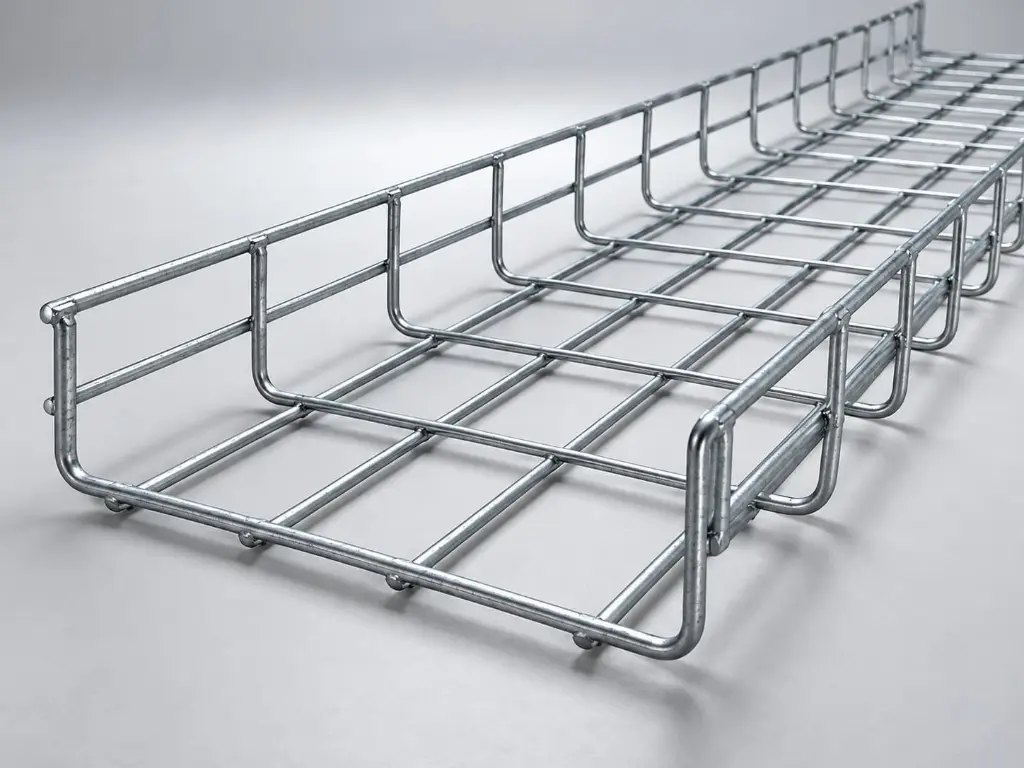
What Is a Wire Mesh Cable Tray?
A wire mesh cable tray consists of interconnected metal wires that form an open supporting structure for electrical cables. Manufacturers produce these trays in different widths, heights, wire diameters, and finishes to suit different applications.
The open design provides convenient access to cables from multiple directions. Installers can also cut and adapt suitable sections to accommodate changes in cable routes, subject to the manufacturer's instructions and project requirements.
Wire mesh cable trays are commonly used for communication cables, data cables, control wiring, and other installations where accessibility and flexibility are important.
Benefits of Wire Mesh Cable Trays
One major advantage of wire mesh cable trays is their accessibility. Technicians can inspect cable routes and add or remove cables without dealing with a completely enclosed support system.
Their open construction also promotes airflow around cables. This can benefit suitable installations, although the final thermal performance depends on cable loading, cable type, spacing, and the surrounding environment.
Wire mesh systems can simplify routing around equipment and through service areas. Their relatively lightweight construction may also make handling easier compared with some heavier cable tray systems.
However, wire mesh trays are not automatically suitable for every cable installation. Engineers should confirm their load capacity, support requirements, and compatibility with the intended cables before approving a system.
Applications in Saudi Arabia
Wire mesh cable trays are useful in offices, commercial buildings, data centres, telecommunications rooms, warehouses, and industrial facilities. In office buildings, they can organise communication, network, and control cables above ceilings or within designated service areas. In warehouses, they can support suitable cable routes for lighting, security, automation, and communication systems.
Industrial facilities may use wire mesh trays for instrumentation and control cables where the system meets the required environmental and mechanical conditions.
For heavy power cables, engineers should evaluate whether a wire mesh tray provides sufficient structural capacity. A ladder cable tray may be more appropriate for some high load applications.
Wire Mesh Cable Tray for Data Centres
Data centres require organised cable pathways that allow technicians to maintain connections and accommodate future expansion. Wire mesh cable trays can support suitable data and communication cables above server racks, cabinets, and network equipment. Their open construction allows technicians to view and access cable routes during maintenance.
Before installation, the project team should coordinate the tray layout with rack positions, cooling systems, power distribution, fire protection, and other services. Cable congestion should also be avoided. An overcrowded tray can make identification and maintenance difficult, even when the tray itself has adequate structural capacity.
Contact Us
Protect your assets with Hitech Fence’s . For consultations, demonstrations, or inquiries:
Choosing the Right Dimensions and Load Capacity
Wire mesh cable trays are available in different widths and heights. The appropriate dimensions depend on the number of cables, cable diameters, routing requirements, and provision for future expansion. Engineers should also assess the combined cable load and confirm that the selected tray can support it across the planned support spans.
Support spacing is particularly important because a tray's performance changes according to the distance between supports and the applied load. The manufacturer's technical data should guide the selection.
For commercial and industrial projects, the cable schedule should be reviewed before the tray size is finalised. This reduces the risk of overcrowding or selecting a system that does not meet the project's requirements.
Material and Corrosion Protection
Wire mesh cable trays are available with different materials and protective finishes. The correct choice depends on the installation environment and project specification.
Galvanized steel can provide corrosion protection for many applications. Other finishes may be suitable for indoor installations, while stainless steel may be considered for demanding environments where the project specification justifies it.
Saudi Arabia's climate makes this assessment important. Outdoor installations near the coast can experience humidity and salt exposure, while industrial sites may introduce additional corrosive conditions.
Project teams should evaluate the expected exposure and select a suitable protective system. The finish should also remain compatible with the fittings, supports, and accessories used throughout the installation.
Wire Mesh Cable Tray in Riyadh, Jeddah and Dammam
In Riyadh, wire mesh cable trays are often considered for indoor commercial facilities, offices, warehouses, and suitable industrial applications. Outdoor installations require attention to heat, dust, and the specified protective finish.
In Jeddah and Dammam, coastal exposure can increase corrosion concerns for exposed metal systems. Jubail and Yanbu projects may also involve industrial environments that require careful material selection. The tray specification should reflect the actual installation conditions rather than relying on a single specification for every Saudi location.
Wire Mesh Cable Tray Accessories
A complete installation may require bends, tees, crosses, connectors, brackets, supports, covers, and cable fixing accessories. These components should be compatible with the selected tray dimensions and material. Using suitable fittings helps maintain alignment and reduces unnecessary modifications on site.
The installer should also follow the manufacturer's instructions when cutting or adapting wire mesh sections. Cut edges should be treated appropriately to avoid sharp exposed ends and to maintain the required corrosion protection. For larger projects, preparing an accessory schedule before procurement can reduce installation delays and missing component issues.
Installation Best Practices
Successful installation starts with an approved route and a clear understanding of the cable requirements. The contractor should coordinate tray positions with structural elements, HVAC systems, fire protection, electrical equipment, and maintenance access.
Supports must be installed according to the approved design and manufacturer's recommendations. The installer should check alignment, connections, clearances, and structural stability before loading the tray with cables.
Cable separation should follow the project design. Power, control, instrumentation, and communication cables may require separate routes or suitable separation measures. The completed system should be inspected for damaged coatings, loose connections, sharp edges, overloaded sections, and inaccessible cable routes.
Wire Mesh Cable Tray vs Ladder Cable Tray
Wire mesh and ladder cable trays serve different needs. Wire mesh trays offer flexibility and convenient access for many communication, data, and control cable applications. Ladder trays have side rails and cross rungs and are frequently considered for heavier power cable routes.
The right choice depends on cable weight, support span, ventilation requirements, installation environment, and project specifications. For example, a data centre may use wire mesh trays for network cables while using a different tray configuration for heavier electrical distribution cables. This application based approach can improve cable organisation and avoid unnecessary material costs.
Common Selection Mistakes
One common mistake is choosing a wire mesh tray without checking the expected cable load. Another is overlooking support spacing or assuming that every tray width provides the same structural performance.
Projects can also encounter problems when the selected finish does not match the environment or when compatible accessories are unavailable. Poor route coordination can create conflicts with other building services and make future maintenance more difficult.
Reviewing the cable schedule, technical data, environmental exposure, and accessory requirements before procurement helps prevent these problems.
How Much Does a Wire Mesh Cable Tray Cost in Saudi Arabia?
The price depends on tray dimensions, wire diameter, material, protective finish, quantity, accessories, support requirements, transportation, and installation complexity. A small indoor installation will have different requirements from a large warehouse or industrial project.
When comparing quotations, buyers should check that suppliers have quoted equivalent specifications. Comparing only the price per metre can be misleading if the products differ in material, load capacity, finish, or included accessories. For an accurate quotation, provide the supplier with drawings, quantities, tray dimensions, installation conditions, and relevant technical requirements.
Choosing a Wire Mesh Cable Tray Supplier
A suitable supplier should provide clear product specifications, compatible accessories, technical documentation, consistent product quality, and dependable delivery. For Saudi projects, buyers should confirm that the proposed tray and protective finish meet the consultant's and client's requirements.
It is also useful to confirm the availability of fittings and supports before placing the order. A complete system helps contractors avoid delays caused by missing components or incompatible products.
Hitech Cable Tray Solutions
Hitech supports cable management requirements for industrial, commercial, and infrastructure projects. Selecting the right solution starts with understanding the application, cable load, dimensions, environmental conditions, supports, and accessories.
Wire mesh cable trays can be considered where accessible cable routing and installation flexibility are priorities. For heavier power applications, engineers should assess whether ladder or another suitable tray configuration better meets the design requirements. The objective is to select a complete cable management system that matches the project's technical and operational needs.
Conclusion
Wire mesh cable trays provide a flexible solution for organising data, communication, control, and other suitable electrical cables across Saudi Arabia. Their open construction supports accessibility, convenient maintenance, and future cable modifications.
Choosing the right system requires careful consideration of dimensions, cable load, support spacing, material, corrosion protection, accessories, and installation conditions.
By reviewing these requirements before procurement, contractors, consultants, and project owners can select a cable tray system that supports reliable installation and long term maintenance.