When physical deterrence is the primary design objective of a perimeter, palisade fencing consistently outperforms every other standard fence type. Its vertical steel pales each with a pointed, rounded, or triple pointed head present an unambiguous physical and visual barrier. Unlike chain link or welded mesh, a palisade fence is specifically engineered to defeat climbing attempts. The pointed tops make it extremely difficult to scale, and the rigid structure resists the kind of physical deformation that more flexible fence types are vulnerable to.
Across Saudi Arabia, palisade fencing is the perimeter solution of choice for petrochemical facilities, government buildings, military installations, substations, water treatment plants, and high value commercial properties. It is frequently specified to meet Saudi Aramco and HCIS/SAIS compliance requirements for industrial and critical infrastructure sites.
At Hitech Fence & Steel, we manufacture and supply palisade fencing to clients across Riyadh, Jeddah, Dammam, Jubail, Yanbu, NEOM, and the wider Kingdom. This guide answers every question a buyer, engineer, or procurement officer in KSA needs before specifying or ordering a palisade fence.
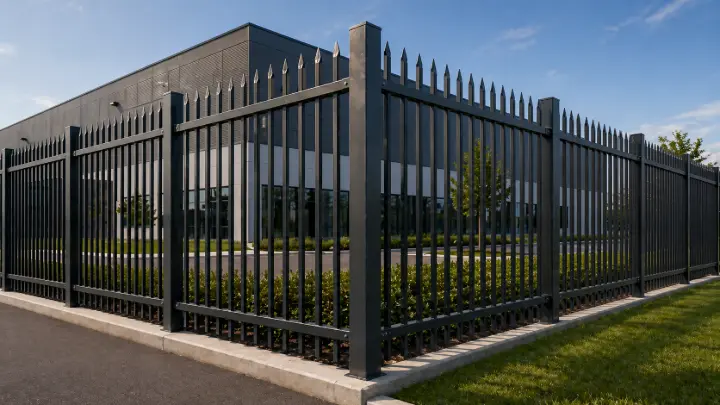
What Is Palisade Fencing?
Palisade fencing consists of vertical steel pales (also called palings or pickets) attached horizontally to two or three steel rails, which are in turn fixed to upright steel posts concreted into the ground. The pales are the defining element of the system; they are typically made from cold rolled steel in a D section, W section (double ribbed), or Triple point (tri point) profile, and protrude above the top rail with a shaped head designed to prevent climbing.
The combination of vertical pales, pointed or shaped tops, rigid structure, and visibility through the fence (important for CCTV surveillance integration) makes palisade the preferred security perimeter for sites where physical resistance to intrusion is the highest priority.
Key components of a palisade fence system
- Pales (palings): Vertical steel members, typically in D section or W section profile. Height above ground: 1.8 m to 3.0 m standard; taller on request.
- Rails: Horizontal members (usually 2 or 3 rails) spanning between posts, to which pales are bolted. W section rail profiles provide the best strength to weight ratio.
- Posts: Upright steel sections (typically RHS or H section) concreted into the ground at 2.75 m centres. Posts carry the entire structural load of the fence.
- Fixings: Pales are bolted to rails using anti vandal fixings (rounded heads, tamper resistant) to prevent the fence being dismantled from the outside.
- Pale heads: The top of each pale is formed into a deterrent profile single point, double point, triple point (tri point), or rounded (bow top for non security applications).
Types of Palisade Fence Available in Saudi Arabia
Standard D Section Palisade
The D section (or semi circular section) is the entry level palisade profile. It provides solid physical deterrence and is widely used for commercial perimeters, utility compounds, and light industrial sites across KSA. D section palisade is lighter than W section and therefore lower in material cost, making it a practical choice when the security requirement does not demand maximum rigidity.
W Section (Double Ribbed) Palisade Most Specified in KSA
W section palisade, named for the double ribbed 'W' profile of the pale cross section, is the most commonly specified palisade type for medium to high security industrial and government perimeters in Saudi Arabia. The W section profile is significantly stronger and more rigid than the D section, resisting physical impact, attempted prying, and deformation under load. It is the standard profile specified in most SAIS and Aramco perimeter security requirements.
Triple Point (Tri Point) Palisade Maximum Deterrence
Triple point palisade features three forward pointing prongs at the head of each pale rather than a single spike. The multi directional points are significantly harder to grip and climb over, making this profile the choice for the highest security perimeters, classified government sites, military installations, critical national infrastructure, and royal estate boundaries. Triple point palisade is also specified where anti-climb performance must meet or exceed specific security standards.
Bow Top Palisade Aesthetic / Public Area Use
Bow top palisade replaces the pointed pale heads with a rounded, curved top. It provides the structural rigidity and boundary definition of palisade without the hostile appearance of pointed heads. Bow top palisade is appropriate for schools, public parks, hospitals, and civic areas in KSA cities where a secure but visually welcoming fence is required. It does not provide the same anti-climb deterrence as pointed variants.
Rotating Spike Top Palisade Ultra High Security
A specialist variant used at the highest risk perimeters, rotating spike tops spin freely when gripped, making hand over hand climbing physically impossible. This system is typically specified for defence, intelligence, and critical infrastructure sites where perimeter security must defeat determined and prepared intruders.
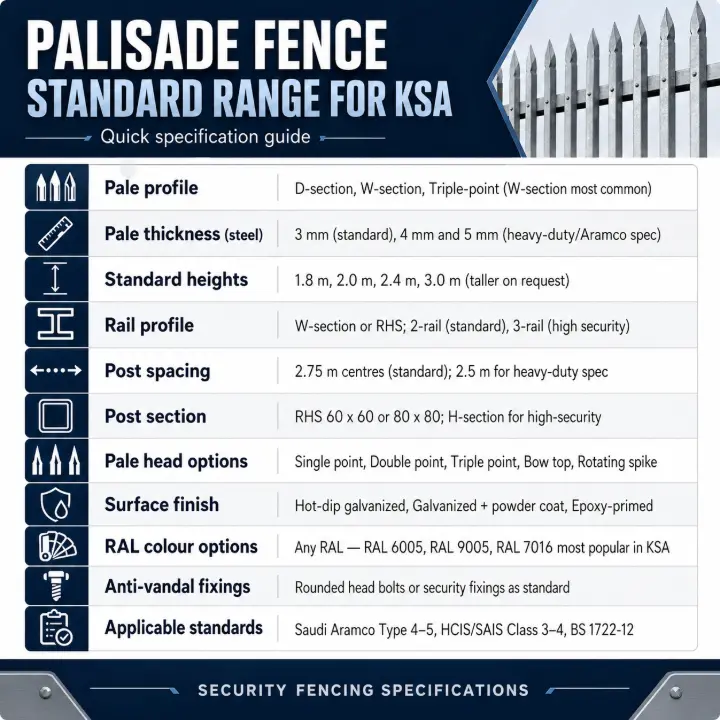
Palisade Fence Specification Reference for KSA Projects
Where Palisade Fencing Is Used Across Saudi Arabia
Palisade fence is specified wherever the combination of high physical security, visual deterrence, and through fence visibility is required. In KSA, the most common application sectors are:
Oil, gas, and petrochemical facilities
Saudi Aramco sites, SABIC facilities, and independent petrochemical plants across Jubail Industrial City, Yanbu Industrial City, and Ras Tanura consistently specify W section or triple point palisade for their primary perimeter. Palisade allows CCTV cameras and security guards to see through the fence an important operational requirement for patrol and remote monitoring.
Power and utility infrastructure
Electrical substations, water treatment plants, desalination facilities, and telecommunications infrastructure across KSA require palisade perimeters that resist physical intrusion while allowing visual monitoring. The rigidity of palisade also means it is less vulnerable to high wind events important for exposed utility sites in the desert interior.
Government and military facilities
Government ministry buildings, police stations, military installations, and intelligence facilities in Riyadh and across the Kingdom specify palisade as the standard perimeter solution. Triple-point and rotating spike variants are common at the highest classification sites.
Airports and transport infrastructure
King Khalid International Airport (Riyadh), King Abdulaziz International Airport (Jeddah), King Fahd International Airport (Dammam), and major highway and rail infrastructure projects specify palisade perimeters that comply with aviation security and transport authority standards.
Commercial and industrial compounds
Factories, logistics warehouses, data centres, and commercial compounds in industrial zones across KSA increasingly specify W section palisades for their external perimeter. The fence's combination of visual deterrence, structural strength, and competitive total cost makes it a strong value choice for medium to high security commercial sites.
Royal estates and high value residential
High value private residences and royal estate perimeters in Saudi Arabia frequently specify custom palisades in ornamental or architectural profiles, powder coated in premium RAL colours, with height and pale spacing adjusted to the specific security and aesthetic requirements of the site.
Palisade vs Welded Mesh vs Chain Link: Security Comparison
A security-focused comparison for KSA projects, covering anti-climb behavior, cut/impact resistance, visibility, deterrence, compliance, and typical applications.
| Security factor | Palisade Fence | Welded Mesh | Chain Link |
|---|---|---|---|
| Climb resistance | Very high — pointed heads and rigid structure | High — rigid panels; anti-climb profiles available | Moderate — diamond pattern provides footholds |
| Cut resistance | High — solid steel pales harder to cut than mesh wire | Moderate — mesh wire can be cut with bolt croppers | Lower — wire fabric cut-resistance depends on gauge |
| Impact resistance | Very high — solid pales absorb impact well | High — rigid panels resist deformation | Low — fabric deflects and can be pushed aside |
| Through-fence visibility | Excellent — gaps between pales enable CCTV and patrol sightlines | Limited — solid panels block sight lines | Good — open diamond pattern allows visibility |
| Visual deterrence | Very high — pointed heads are a strong psychological barrier | Moderate — clean appearance, less intimidating | Low — does not visually signal high security |
| Aramco/SAIS compliance | Yes — Type 4–5 and Class 3–4 compliant specs available | Yes — Type 1–3 and Class 1–3 compliant specs | Yes — Type 1–3 compliant specs |
| Typical application | High-security industrial, government, infrastructure | Commercial, residential, medium-security industrial | Boundary marking, light industrial, agriculture |
Palisade Fence Performance in the Saudi Arabian Climate
Palisade fence's solid steel construction particularly in the W section profile is inherently robust in KSA's demanding climate. The main considerations are:
Surface finish selection by region
Inland KSA (Riyadh, Hail, Tabuk): Hot dip galvanized palisade provides excellent protection against UV, heat, and abrasive sandstorm exposure. Powder coat over galvanized extends service life and adds colour.
Coastal KSA (Jeddah, Dammam, Yanbu, Jizan): PVC coated or high build marine grade powder coat is essential. The salt air environment accelerates corrosion at any pinhole defect in the coating. Hitech Fence applies a minimum 80 micron powder coat for coastal KSA projects.
Industrial zones (Jubail, Yanbu Industrial City): Chemical exposure from neighbouring facilities adds an additional corrosion risk. Epoxy primed paint systems or stainless steel fasteners are recommended throughout.
Wind load performance
Desert sandstorms and shamal winds in KSA create significant wind loads on perimeter fences. Palisade fence, with its open pale structure, allows wind to pass through the gaps dramatically reducing the wind load on posts and foundations compared to solid panel systems. This makes palisade particularly well suited to exposed sites in the Saudi interior.
How to Specify Palisade Fence for a KSA Project
Use this five step framework when specifying palisade fence for any project in Saudi Arabia:
- Define the security classification. Identify whether your site falls under Aramco, HCIS/SAIS, or another regulatory framework. This determines the minimum pale gauge, height, and fixing specification.
- Select the pale profile. The W section with a triple point head is the most versatile choice for KSA industrial and government sites. D section suits commercial perimeters with lower security classification.
- Specify the height. 2.4 m is the standard for most commercial and industrial perimeters in KSA. 3.0 m or taller is specified for the highest security sites. Aramco and SAIS standards define minimum heights by site classification.
- Choose the surface finish. Hot dip galvanized plus powder coat for inland sites. Marine grade high build powder coat or PVC coated for coastal KSA environments. Specify the RAL colour at the inquiry stage.
- Request compliance documentation. For Aramco, HCIS/SAIS, and Royal Commission projects, material test certificates, mill certificates, and product compliance statements are required. Hitech Fence provides a full documentation package with every compliant supply.
Frequently Asked Questions