If you have received a fencing quotation for a project in Saudi Arabia recently, you have almost certainly seen both chain link fence and welded mesh fence listed as options. On paper, they appear similar, both are manufactured from steel wire, both are available galvanized or powder-coated, and both define a perimeter. In practice, they perform very differently.
Choosing the wrong type creates real problems. Chain link installed on a facility where a higher standard of climb resistance is required creates a security gap. Welded mesh specified for a temporary construction site boundary adds unnecessary cost. The decision matters and it is one that our engineering team at Hitech Fence & Steel discusses with clients every week.
This guide gives you a clear, practical, and honest comparison of both fence types covering every factor that matters for KSA projects.
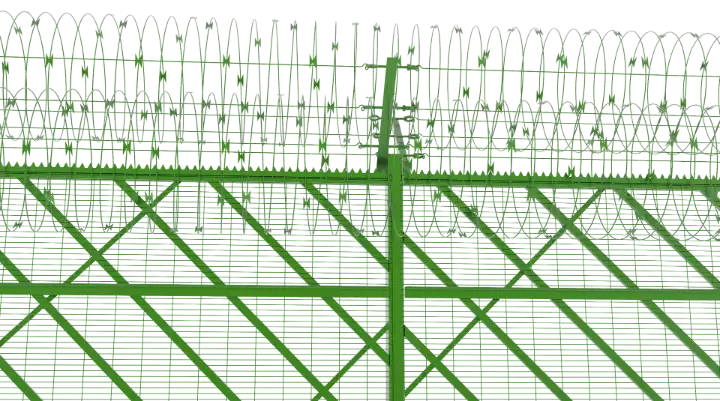
What Is Chain Link Fence?
Chain link fence also called cyclone fence or diamond mesh fence is made from a single continuous steel wire woven in a spiral to create interlocking diamond-shaped openings. The resulting fabric is attached to a system of steel posts and top and bottom rails. It is one of the most widely installed fence products in the world, and remains one of the most popular in Saudi Arabia.
Key specifications for KSA projects
- Wire gauge: 2.0 mm to 3.5 mm heavier gauge provides stronger fabric and higher cut resistance
- Mesh aperture: 50 mm diamond is most common; 60 mm also available for light boundary applications
- Heights: 0.9 m (light boundary) to 4.0 m (high perimeter); taller custom heights on request
- Finish options: Galvanized (zinc-coated), PVC-coated in green, black or brown, powd
Steel posts are driven or concreted into the ground at 2.5 m to 3.0 m centres. A top rail and optional bottom rail span between posts. The chain link fabric is unrolled along the fence line and tensioned using tension bars and wire ties. No special plant is required. Installation is fast, and the process suits both flat and uneven ground.
What Is Welded Mesh Fence?
Welded mesh fence also known as rigid panel fence or welded wire panel fence is manufactured by welding horizontal and vertical steel wires together at every intersection using electric resistance welding. The result is a rigid, flat panel rather than a flexible fabric. Panels are pre-fabricated in standard sizes (typically 2.0 m wide x 1.2 m to 2.4 m tall) and fixed to posts using specialist clamps or brackets.
Key specifications for KSA projects
- Wire diameter: 4 mm, 5 mm, and 6 mm are most common for commercial and industrial use in KSA
- Mesh aperture: 50 x 200 mm and 50 x 100 mm are standard; anti-climb profiles as tight as 12.5 x 76 mm
- Panel profiles: Flat 2D panels and wave-bent 3D panels (3D50, 3D38, 3D Extra) for increased rigidity
- Finish options: Hot-dip galvanized, electro-galvanized with powder coat (most popular in KSA), PVC-coated
How welded mesh is installed
Posts are concreted into the ground. Pre-fabricated panels are slotted onto posts or secured via clamps at consistent heights. Because every panel arrives dimensionally identical and ready to fix, welded mesh installation is clean, fast, and produces a uniform appearance especially important for large commercial and industrial projects where consistency matters.
Head-to-Head Comparison: Every Factor That Matters in KSA
A detailed side-by-side comparison of Chain Link Fence vs Welded Mesh Fence for Saudi Arabia, covering security, compliance, lifecycle, and project suitability.
| Factor | Chain Link Fence | Welded Mesh Fence |
|---|---|---|
| Security level | Moderate — flexible fabric can be pushed, bent, or cut with effort | High — rigid panels resist deformation; small aperture options deter cutting |
| Climb resistance | Lower — diamond openings act as natural footholds | Higher — flat rigid surface with no footholds; 3D profiles add further deterrence |
| Aesthetics | Industrial / utilitarian — functional but basic | Modern and architectural — clean lines; premium finish options |
| Terrain adaptability | Excellent — fabric follows uneven ground naturally | Moderate — panels may need adapting on very irregular terrain |
| Installation speed | Fast — rolled fabric deploys quickly over long runs | Fast — pre-fabricated panels fix rapidly to posts |
| Material cost (per m) | Lower — typically 15–30% less than welded mesh | Moderate to higher — depends on wire gauge and panel profile |
| Maintenance cost | Low — damaged sections of fabric replaced as needed | Very low — individual damaged panels replaced independently |
| Lifespan (KSA inland) | 15–25 years (galvanized) | 20–30 years (galvanized + powder coat) |
| Lifespan (KSA coastal) | 20+ years (PVC-coated) | 25+ years (high-build powder coat or PVC-coated) |
| Aramco/SAIS compliance | Yes — select specs meet Type 1–3 | Yes — select specs meet all Aramco and HCIS/SAIS types |
| Colour & customisation | Limited — standard galvanized or PVC colours | High — any RAL colour, custom profiles, 3D designs |
| Best for large perimeters | Yes — most cost-effective over 1 km+ runs | Better for medium projects where appearance and security matter |
Security Performance Compared
When chain link is the right security choice
For low to medium security requirements residential boundary walls, school perimeters, sports facilities, parking areas, warehouses, and large agricultural or utility land chain link provides effective deterrence at the lowest cost per metre. The fence clearly defines a boundary, physically restricts casual access, and performs reliably for decades with minimal maintenance.
When welded mesh delivers better security
When your site requires a fence that is harder to climb, cut, or physically deform under pressure commercial facilities, industrial compounds, government buildings, embassies, data centres, and oil and gas perimeters welded mesh panels offer a genuine security upgrade. Their rigid construction eliminates the flex that makes chain links relatively easy to scale. Anti-climb panel profiles, with small apertures and high-rigidity 3D bending, make penetration substantially more difficult.
When neither is enough
For the highest-risk perimeters in KSA Aramco-classified sites, HCIS Class 3 - 4 installations, royal estate boundaries, and military perimeters both standard chain link and standard welded mesh may be insufficient as a standalone system. Hitech Fence designs integrated high-security perimeter systems combining welded mesh panels with anti-climb toppers, electric fence integration, CCTV mounting rails, and vehicle barriers.
Aesthetics: Increasingly Important for KSA's Vision 2030 Developments
Until recently, fencing in Saudi Arabia was specified almost entirely on security and cost criteria. Vision 2030 has changed this. Developers of residential communities, mixed-use retail, hospitality, and public realm projects now treat the perimeter fence as part of the architectural language of the development.
Chain link functional but limited aesthetically
Chain link is a utility product. PVC-coated chain link in dark green or black blends more naturally into landscape settings than bare galvanized wire, but it remains recognisably industrial. For premium residential compounds, hospitality projects, or public-facing commercial developments in cities like Riyadh, Jeddah, and NEOM, chain link frequently fails to meet developer design standards.
Welded mesh the architectural choice
Powder-coated welded mesh panels in colours such as RAL 6005 (dark green), RAL 7016 (anthracite grey), and RAL 9005 (jet black) are architecturally clean and integrate smoothly with contemporary building materials glass, cladding, and rendered concrete. Many KSA master planners now specify fence colour and profile as part of design guidelines, and welded mesh consistently satisfies these requirements.
Hitech Fence manufactures powder-coated welded mesh panels in any RAL colour at its Saudi Arabia production facility. Custom 3D panel profiles, decorative top finishes, and laser-cut design elements are all available for projects where the fence is part of the visual identity of the development.
Durability in Saudi Arabia's Climate
The KSA climate is one of the most demanding in the world for steel products. The finish you specify is as important as the fence type itself.
Inland KSA Riyadh, Hail, Tabuk, Al Qassim
- Primary threats: UV radiation, extreme heat (regularly exceeding 45°C), and abrasive sandstorms that erode surface coatings
- Recommended finish: Hot-dip galvanized base coat with powder coat overcoat. Both chain link and welded mesh perform reliably in inland KSA with this specification.
Coastal KSA Jeddah, Dammam, Yanbu, Jizan, Khobar
- Primary threat: Salt-laden humid air accelerates galvanic corrosion on bare steel and through pinhole defects in coatings
- Recommended finish: PVC-coated chain link (the PVC skin is impermeable to salt air) or high-build marine-grade powder coat on welded mesh panels. Stainless steel fasteners should be used throughout.
Industrial zones Jubail Industrial City, Yanbu Industrial City
- Primary threats: Chemical exposure from petrochemical production in addition to coastal salt air
- Recommended finish: PVC-coated or epoxy-primed powder coat; consider 316-grade stainless steel wire or components in extreme exposure zones.
Cost Comparison for Saudi Arabia Projects
Cost is a major consideration on large perimeter projects where a fence line runs for hundreds or thousands of metres. The following is a realistic guide based on current KSA market pricing:
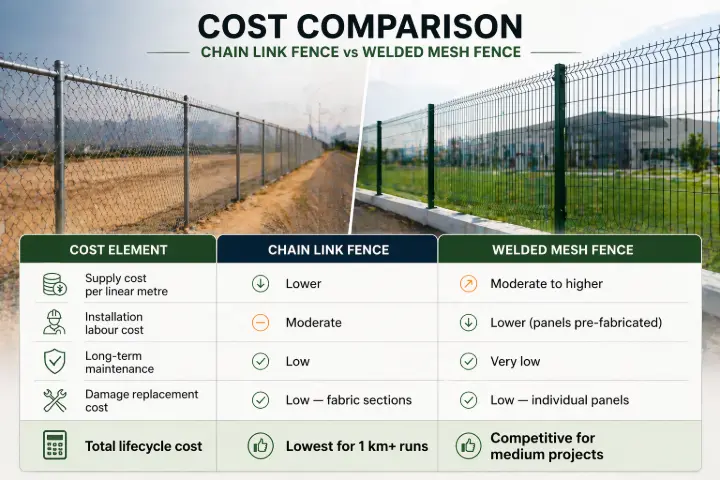
The supply cost gap between chain link and welded mesh narrows when you factor in the lower labour cost of installing pre-fabricated panels. For projects up to 500 m, the total installed cost difference is often smaller than buyers expect. For projects exceeding 1 km, chain link's material cost advantage becomes significant.
Quick Decision Guide: Which Fence for Your KSA Project?
Choose chain link fence when:
- You are fencing a large agricultural, utility, or infrastructure perimeter where cost-per-metre is the primary driver
- The installation is temporary or may need to be relocated chain link is easily dismantled, transported, and reinstalled
- Moderate boundary marking and basic deterrence are sufficient for your project's security requirement
- The terrain is uneven or irregular and a flexible product that follows ground contour is needed
- Delivery and installation timeline is critical chain link can be manufactured and deployed faster
Choose welded mesh fence when:
- Your project is a residential compound, commercial property, school, hospital, government building, or public facility
- The fence specification requires higher climb resistance and resistance to deformation than standard chain link provides
- Compliance with Saudi Aramco, HCIS/SAIS, or Royal Commission fencing standards is a project requirement
- The fence will be visible to residents, visitors, or the public and its appearance reflects on your development
- Long service life with minimal maintenance is important to an asset-holding or facilities management client
Consider a hybrid specification when:
Many large KSA industrial and commercial projects adopt a mixed approach: welded mesh panels on street-facing elevations for security and aesthetics, and chain link on less visible back-of-site perimeters where cost control is the priority. Hitech Fence designs and supplies mixed-specification perimeter systems tailored to project budget and security zoning plans
Frequently Asked Questions