Perforated cable trays provide a practical way to support and organise electrical cables in industrial, commercial, infrastructure, warehouse, and utility projects across Saudi Arabia. Their continuous base with regular perforations provides cable support while allowing installers to secure cables at suitable points along the route.
Perforated cable trays are commonly used for power, control, instrumentation, automation, and general electrical cable installations. The correct specification depends on cable weight, tray dimensions, support spacing, installation environment, corrosion protection, and project requirements.
Saudi Arabia has diverse construction and industrial environments. A cable tray installed inside an electrical room in Riyadh has different requirements from one installed outdoors in Jubail, Dammam, Jeddah, or Yanbu. For this reason, selecting a perforated cable tray requires more than comparing width and price.
What Is a Perforated Cable Tray?
A perforated cable tray is a cable support system manufactured with a series of openings in its base and side sections. These openings reduce the overall weight of the tray while providing convenient points for cable fixing and installation accessories.
The continuous supporting surface underneath the cables makes perforated trays different from open ladder cable trays. They are available in different widths, depths, material thicknesses, and protective finishes.
The correct configuration should always be selected according to the cable schedule, expected load, support span, environmental conditions, and project specification.
Why Use a Perforated Cable Tray?
Perforated cable trays offer a practical balance between cable support, accessibility, and installation flexibility. The continuous base provides support across the cable route, while the perforations allow installers to secure cables using suitable fixing methods.
They can also provide ventilation around cables, depending on the installation arrangement. This makes them suitable for many electrical applications where the project does not require a fully enclosed cable pathway.
However, engineers should not select a tray based only on appearance or dimensions. Material thickness, support spacing, cable weight, and construction all affect the actual performance of the system.
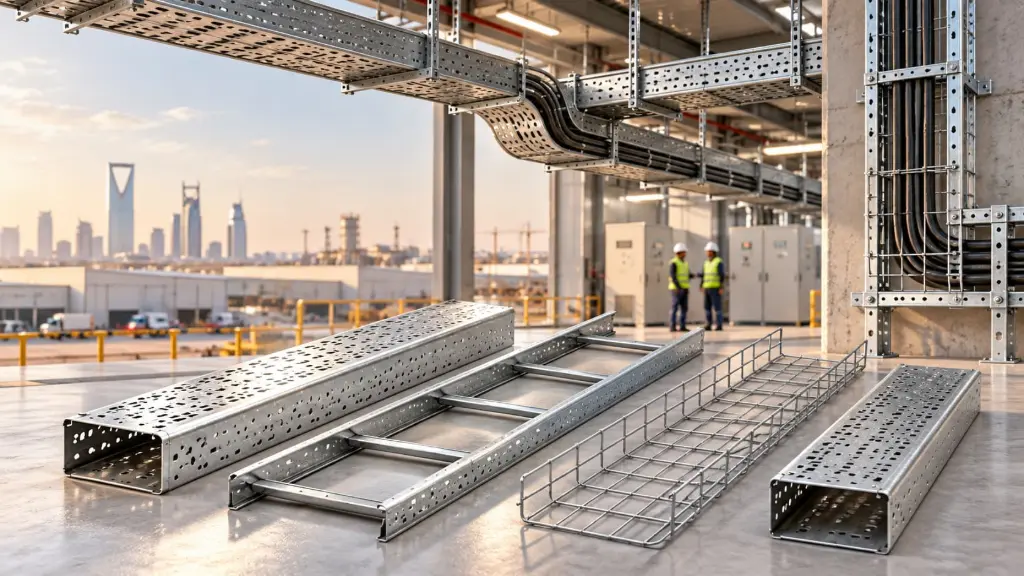
Applications of Perforated Cable Tray in Saudi Arabia
Perforated cable trays are used across many types of Saudi projects. Industrial facilities can use them for control, power, instrumentation, and automation cables. Commercial buildings may use them for electrical distribution, lighting, communication, and building management systems.
Warehouses can require cable trays for lighting, security systems, automation, charging equipment, and conveyor systems. Infrastructure and utility projects may also use perforated trays where cables require continuous support and an organised route.
The final tray selection should always reflect the application and cable requirements.
Perforated Cable Tray for Industrial Projects
Industrial facilities often have complex cable routes connecting motors, control panels, production equipment, instrumentation systems, pumps, and other machinery.
Perforated trays can provide an organised pathway while allowing installers to secure cables along the route. However, industrial environments may expose the cable tray to heat, dust, moisture, chemicals, or vibration.
The material and protective coating should therefore match the actual site conditions. A tray suitable for an indoor electrical room may not be suitable for an exposed industrial installation.
Perforated Cable Tray Load Capacity
Load capacity is one of the most important considerations when selecting a perforated cable tray.
Engineers should calculate the combined weight of the cables and tray over the intended support span. The manufacturer's technical information should then be used to verify that the proposed tray configuration can handle the expected load.
Support spacing also affects performance. A tray that performs well over a short span may not provide the same structural performance over a longer span.
For large industrial projects, the tray specification and support arrangement should therefore be considered together during design.
Material and Coating Selection
Steel is widely used for perforated cable trays because it provides good structural strength. The protective finish depends on the installation environment.
Galvanized steel is commonly considered for industrial and outdoor applications where corrosion protection is required. Stainless steel may be considered for more aggressive environments when the project specification requires additional corrosion resistance.
For Saudi projects, the selection should consider the actual exposure rather than using the same material specification everywhere.
A properly specified galvanized cable tray can provide a practical solution for applications where corrosion protection is an important requirement.
Perforated Cable Tray in Riyadh and Coastal Areas
Riyadh projects can experience high temperatures, dust, and strong sunlight, particularly for outdoor installations. The cable tray coating should be suitable for the expected exposure. Coastal locations such as Jeddah, Dammam, Jubail, and Yanbu require additional attention to corrosion because humidity and salt exposure can affect exposed steel systems.
Project teams should select the protective finish according to the actual installation environment. Contractors should also avoid unnecessary damage to the coating during handling, cutting, drilling, and installation.
Perforated Cable Tray Accessories
A complete cable tray system requires more than straight sections. Depending on the route, the installation may require bends, tees, crosses, reducers, couplers, covers, brackets, supports, and cable fixing components.
Accessories should match the tray dimensions and construction. Using compatible fittings reduces the need for unnecessary site modifications and helps maintain consistent installation quality. For large projects, preparing the accessory schedule before procurement can prevent delays caused by missing fittings during installation.
Perforated Cable Tray Installation
Installation should begin after the cable route, support positions, tray dimensions, and accessories have been coordinated. Supports should be installed according to the approved design and manufacturer's recommendations. Tray sections should remain properly aligned and securely connected.
The route should also be coordinated with mechanical services, fire protection systems, structural elements, equipment, and maintenance access. During installation, contractors should inspect the protective coating and repair any damage according to the project specification.
Cable Arrangement and Fixing
Cable arrangement affects accessibility, maintenance, and thermal performance. Power, control, instrumentation, and communication cables may require separation according to the electrical design. Cables should not be unnecessarily compressed into the tray.
Perforations provide convenient locations for suitable cable fixing systems. The selected fixing method should match the cable type and installation requirements. Large power cables may require appropriate cleats to control movement and maintain their position. The electrical engineer should determine the appropriate arrangement where fault condition forces need to be considered.
Perforated Cable Tray vs Ladder Cable Tray
Perforated and ladder cable trays serve different requirements. Perforated trays provide a continuous supporting surface and convenient fixing points. Ladder trays have an open structure with side rails and cross rungs and are frequently used for heavy power cable applications.
The choice depends on cable weight, ventilation requirements, installation environment, support arrangement, and project specifications. There is no single tray type that is suitable for every application. Engineers should select the configuration according to the actual cable route and operating conditions.
Common Selection and Installation Problems
One common problem is selecting the tray before confirming the actual cable load. Another is using support spans without checking the manufacturer's technical information. Projects can also experience difficulties when accessories do not match the tray dimensions or when the protective coating becomes damaged during installation.
Poor route coordination can create clashes with other services and make future maintenance difficult. These issues can usually be reduced through proper engineering, accurate drawings, compatible accessories, and early coordination between the supplier, consultant, contractor, and electrical team.
How Much Does a Perforated Cable Tray Cost in Saudi Arabia?
The cost depends on several factors, including tray width, depth, material thickness, coating, quantity, accessories, support requirements, transportation, and installation. A small indoor installation will have different requirements from a large industrial project with long outdoor cable routes.
For this reason, buyers should compare complete technical specifications rather than looking only at the price per metre. A proper quotation should include tray sections, fittings, supports, coating requirements, quantities, and delivery requirements.
How to Choose a Perforated Cable Tray Supplier
A reliable supplier should be able to provide a complete and compatible cable tray system. Project teams should review manufacturing capability, material quality, tray dimensions, material thickness, protective coating, accessory availability, technical documentation, production capacity, and delivery capability.
Experience with Saudi industrial and commercial projects can also help suppliers understand local environmental and installation requirements. For major projects, technical support during design and procurement can help prevent compatibility and installation problems.
Hitech Perforated Cable Tray Solutions
Hitech can support cable management requirements for industrial, commercial, infrastructure, and other projects in Saudi Arabia. The appropriate tray configuration can be selected according to cable type, cable load, dimensions, environmental exposure, support arrangement, accessories, and future expansion requirements.
Perforated trays can be considered where a continuous supporting surface and flexible cable fixing are required. For heavier power routes, another tray configuration may be more appropriate. The objective should always be to match the cable management system to the actual project requirements rather than selecting a product based only on price.
Final Thoughts
Perforated cable trays provide a practical solution for many electrical installations across Saudi Arabia. Their continuous supporting surface, perforated construction, flexible cable fixing options, and range of available sizes make them suitable for industrial, commercial, warehouse, infrastructure, and utility applications.
Correct selection requires consideration of cable weight, material thickness, support spacing, protective coating, environmental exposure, accessories, cable arrangement, and future expansion.
Saudi Arabia's environmental conditions also need attention. Riyadh projects may require consideration of heat and dust, while coastal locations such as Jeddah, Dammam, Jubail, and Yanbu may require stronger attention to corrosion protection. When the tray, fittings, supports, cable fixing system, material, and installation method are properly coordinated, a perforated cable tray can provide a reliable and maintainable pathway for electrical infrastructure.