Cable tray support systems provide the structural foundation needed to hold cable trays safely along their installation routes. In industrial facilities, commercial buildings and infrastructure projects, selecting suitable brackets, channels, hangers and support arrangements is essential for maintaining cable alignment and managing cable loads.
In Saudi Arabia, cable tray supports must be selected according to the installation environment, tray configuration, loading requirements and project specifications. A suitable support arrangement helps prevent excessive deflection, improves installation stability and makes cable routing easier to maintain.
This guide explains the main types of cable tray supports, where they are used and what engineers and contractors should consider when specifying them for Saudi projects.
What Are Cable Tray Support Systems?
A cable tray support system consists of the structural components used to hold cable trays in position. These components transfer the weight of the tray and its cables to the building structure or supporting framework. Depending on the installation, supports may be fixed to concrete ceilings, steel structures, walls, equipment platforms or dedicated cable support frameworks.
The support system must accommodate the combined weight of the tray, installed cables and any additional loads identified in the project design. It should also account for the installation environment, structural conditions and required access for inspection or maintenance.
Selecting supports is therefore an engineering decision, not simply a matter of choosing brackets that fit the tray.
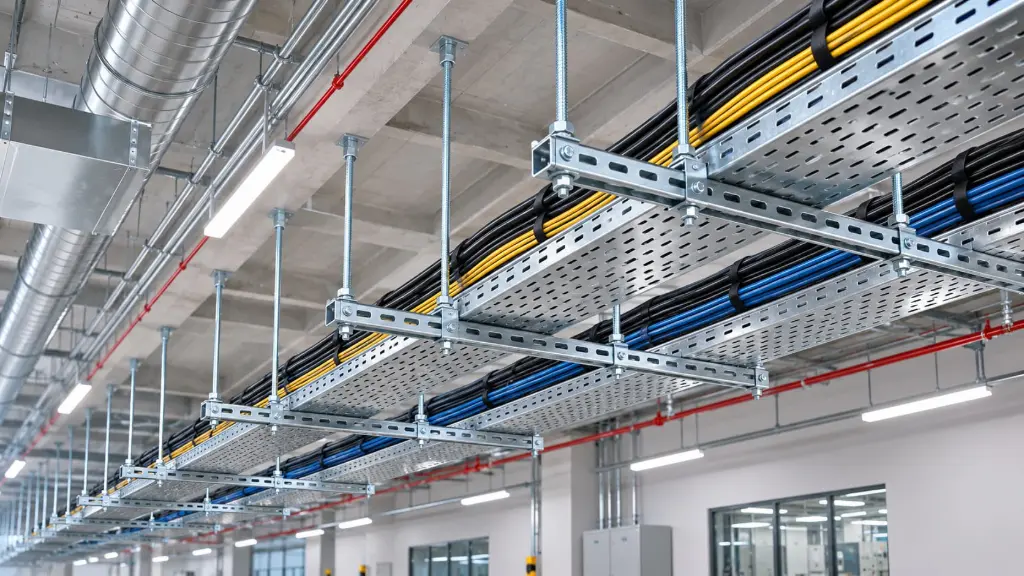
Common Types of Cable Tray Supports
Different installations require different support arrangements. The choice depends on available space, tray width, routing direction, structural access and project requirements.
1. Cantilever Cable Tray Brackets
Cantilever brackets are commonly used for wall mounted cable tray installations. They project horizontally from a wall or structural surface, allowing the tray to rest on the bracket. They are useful in plant rooms, industrial buildings, service corridors and other locations where ceiling suspension is difficult or unnecessary.
The bracket's dimensions and fixing arrangement should be selected according to the tray width, expected loading and supporting wall or structure. The anchor system must also be suitable for the base material.
2. Trapeze Cable Tray Supports
Trapeze supports typically use two threaded rods suspended from an overhead structure, connected by a horizontal support channel. The cable tray is installed on the channel. This arrangement is useful when supporting wider trays or multiple parallel cable routes. It can also help organise cable infrastructure in warehouses, factories and commercial buildings.
The support channel, threaded rods, anchors and connections must be assessed as one assembly. Their suitability depends on the total supported load, support spacing and structural attachment.
3. Channel and Strut Supports
Metal support channels, often called strut channels, provide a flexible framework for cable tray installations. They can be used with brackets, clamps, threaded rods and other compatible accessories. Channel systems are particularly useful when project layouts require adjustable mounting positions or multiple service routes.
Their modular design can simplify coordination with electrical and mechanical services. However, the selected channel profile and connections must have sufficient capacity for the intended application.
4. Ceiling Mounted Supports
Ceiling mounted arrangements suspend cable trays from overhead structures using suitable rods, brackets or support frames. They are commonly used in industrial buildings, service areas, warehouses and large commercial facilities where cable routes run above operational spaces.
The installation must consider available ceiling clearance, structural attachment points, access requirements and possible interference with lighting, ventilation and other building services.
5. Floor and Rack Mounted Supports
Some installations require cable trays to be supported by floor mounted frames, equipment racks or dedicated steel structures. These arrangements can be useful in industrial plants, utility areas and locations where overhead or wall mounti4ng is not practical.
The support structure should provide adequate stability and allow access for cable installation, inspection and maintenance.
How to Select the Right Cable Tray Support
The correct support arrangement depends on several connected design factors.
Tray width and configuration: The support must accommodate the selected tray dimensions and geometry. Wider trays may require different support arrangements from narrow cable routes.
Total loading: Engineers should consider the combined weight of the tray, installed cables and any other loads identified in the design. The support system must be suitable for the intended loading conditions.
Support spacing: The distance between supports affects tray deflection and overall system performance. It should be determined using the manufacturer's documented load data, applicable standards and project engineering requirements.
Structural attachment: Concrete, steel and masonry structures require suitable fixing methods. Anchors and connections must be selected for the actual base material and design loads.
Environmental exposure: Outdoor, coastal and industrial installations may require additional corrosion protection. The support material and finish should be compatible with the exposure conditions.
Maintenance access: Support locations should allow practical access for inspection, cable additions and maintenance without creating unnecessary obstructions.
Cable Tray Support Requirements in Saudi Arabia
Saudi Arabia has a wide range of installation environments, from indoor commercial developments to industrial facilities and outdoor infrastructure projects. These conditions can influence both the support material and the mounting arrangement.
For example, outdoor installations in coastal locations may face greater exposure to moisture and airborne salts. Industrial environments may introduce additional exposure to chemicals, dust or process related contaminants.
In such situations, corrosion protection should be considered for the complete support assembly, including brackets, channels, threaded rods, nuts, bolts and anchors where applicable. Hot dip galvanized steel, stainless steel and other suitable materials may be considered depending on the project specification and environmental conditions. The appropriate choice should be confirmed through engineering review rather than assumed to be the same for every Saudi installation. Projects should also consider the applicable electrical requirements, structural design criteria, client specifications and relevant cable tray standards.
Common Mistakes in Cable Tray Support Installation
One frequent mistake is selecting support spacing without checking the manufacturer's load data. A spacing arrangement suitable for one tray configuration may not be appropriate for another.
Another issue is using brackets or channels without confirming their capacity. The strength of the complete assembly depends on the bracket, support channel, fasteners, anchors and supporting structure. Corrosion protection is also sometimes considered only for the cable tray itself. In practice, the supports and connecting hardware need appropriate protection as well, particularly in exposed environments.
Poor coordination can create additional problems. Supports installed without considering other building services may obstruct access, interfere with equipment or require costly modifications later. Finally, installers should avoid assuming that all support accessories from different systems are automatically compatible. Dimensions, connection methods and manufacturer requirements should be checked before installation.
What Should Buyers Include in a Cable Tray Support Enquiry?
A detailed enquiry helps suppliers understand the project and recommend suitable support components. Buyers should provide the cable tray type and width, proposed routing arrangement, installation method and required support quantities. Information about the supporting structure, environmental exposure and project specifications is also valuable.
Where available, include drawings showing the cable tray route, mounting locations and relevant structural details. If the project has defined loading criteria or support spacing, these should also be shared. The supplier can then review the required brackets, channels, threaded rods, clamps, connectors and fixing accessories against the submitted information.
For larger projects, requesting technical drawings and supporting product documentation before procurement can help reduce compatibility issues and installation changes.
Find Suitable Cable Tray Support Solutions for Your Project
A reliable cable tray installation depends on the compatibility of the tray, support brackets, mounting channels and structural connections. Selecting these components according to the actual loading and environmental conditions helps create a stable and maintainable cable management system.
Hitech Fence supports cable management requirements for industrial and infrastructure applications in Saudi Arabia. Share your cable tray dimensions, installation drawings, support requirements and project specifications with the team to discuss suitable product options.
Frequently Asked Questions