Choosing the right cable tray material and protective finish is an important part of electrical installation planning in Saudi Arabia. Cable trays must support the intended cable load while providing suitable resistance to corrosion, temperature exposure and the conditions of the installation environment.
A tray installed inside a dry commercial building may have different material requirements from one exposed to coastal air, industrial chemicals or outdoor weather. Selecting an unsuitable material can increase maintenance requirements and shorten the service life of the installation.
For electrical engineers, contractors, consultants and procurement teams, understanding the differences between galvanized steel, stainless steel, aluminum and other available finishes helps simplify product selection. The best option depends on the project specification, environmental exposure, structural requirements and total cost over the expected service life.
Why Cable Tray Material Matters
Cable tray material affects structural performance, corrosion resistance, weight, installation requirements and long term maintenance. It also influences compatibility with the supporting structure and the surrounding electrical system.
Material selection should begin with the installation environment rather than price alone. A lower initial purchase price may not represent the best value if the tray requires frequent maintenance or does not provide the protection needed for the application.
For projects in Saudi Arabia, buyers should consider whether the installation is indoors or outdoors, whether moisture or corrosive substances are present, and whether the system will be exposed to coastal conditions or industrial processes. The selected tray must also meet the project's required load capacity and dimensional specifications. Corrosion resistance alone does not establish whether a tray is structurally suitable.
Galvanized Steel Cable Trays
Galvanized steel cable trays are used in many commercial, industrial and infrastructure applications because they combine steel's structural properties with a protective zinc coating.
The coating helps protect the underlying steel against corrosion. However, performance depends on the galvanizing method, coating thickness, surface condition, installation quality and exposure environment.
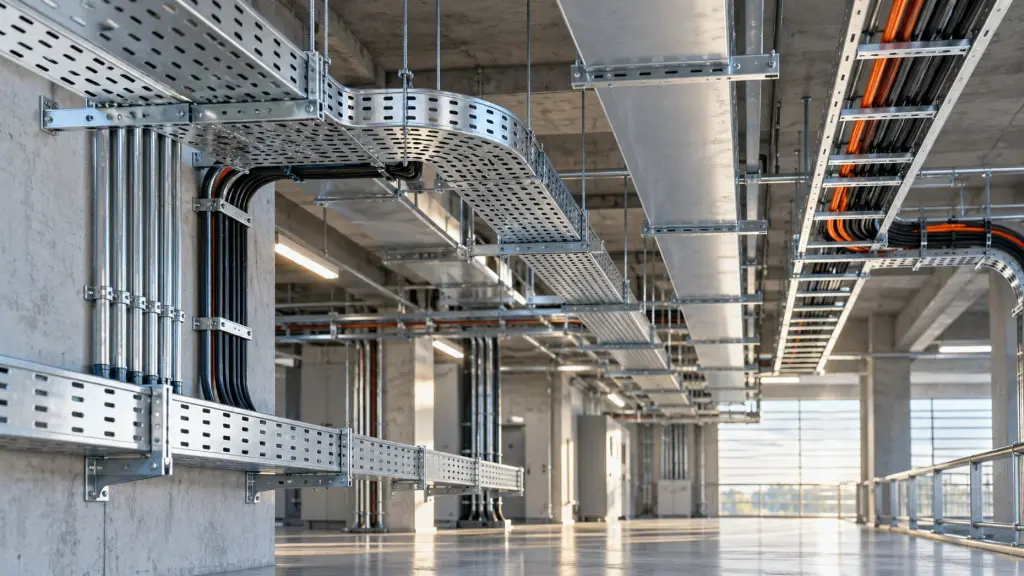
Hot Dip Galvanized Cable Trays
Hot dip galvanized steel is coated by immersing the steel component in molten zinc under a controlled process. The resulting coating provides corrosion protection and may be suitable for demanding environments when the coating specification matches the exposure conditions.
These trays may be considered for industrial facilities, outdoor cable routes, utility installations and other projects where corrosion protection is required.
Buyers should confirm whether the product is galvanized after fabrication or manufactured from previously coated steel. These processes are not interchangeable in every application, particularly where cut edges, drilled holes, welds or complex fabricated components are involved.
Pre Galvanized Cable Trays
Pre galvanized trays are generally manufactured from steel that received a zinc coating before the tray was formed. They can be suitable for many indoor installations, depending on the coating specification and project requirements.
Fabrication may expose areas that need additional consideration, so the suitability of the finish should be evaluated against the intended environment and manufacturer's guidance.
For outdoor or corrosive applications, do not assume that every pre- galvanized product provides the same protection as a tray galvanized after fabrication.
Stainless Steel Cable Trays
Stainless steel cable trays may be suitable for installations that require additional corrosion resistance, durability or particular hygiene characteristics.
They can be considered for selected food processing facilities, chemical environments, marine related applications and industrial locations where ordinary coated steel may not provide the required performance.
The grade of stainless steel is important. Different grades offer different resistance to corrosion, and the presence of chlorides, cleaning chemicals or industrial contaminants can affect material performance.
For coastal and industrial projects in Saudi Arabia, specify the stainless steel grade according to the actual exposure conditions. Confirm compatibility with fasteners, brackets and other connected components to reduce the risk of localized corrosion.
Although stainless steel can have a higher initial cost than conventional galvanized steel, its suitability should be evaluated against maintenance needs, service life expectations and project requirements.
Aluminum Cable Trays
Aluminum cable trays offer a relatively lightweight alternative to steel systems. Their lower weight can help reduce handling effort and may be beneficial where structural weight or installation access is a concern.
Aluminum naturally forms a protective oxide layer, but its performance depends on the alloy, surface condition and surrounding environment. Contact with dissimilar metals in the presence of moisture can also create galvanic corrosion risks.
Where aluminum trays connect to steel supports or other metallic components, the design should consider material compatibility and any required isolation measures. Aluminum may be suitable for certain commercial, industrial and outdoor applications when its load capacity, environmental performance and project specifications are verified. It should not be selected solely because it is lighter than steel.
Understanding Cable Tray Protective Finishes
The base material and the protective finish are related but different aspects of cable tray selection. A steel tray may be supplied with different coatings, each offering a particular level of protection and requiring suitable handling and maintenance. The following options are commonly considered, depending on the product and application.
Zinc Coatings
Zinc coatings protect steel by acting as a barrier and providing sacrificial protection under suitable conditions. The level of protection depends on coating thickness, continuity, exposure and the quality of the application.
The term galvanized steel covers different manufacturing processes, so procurement documents should identify the required finish rather than using the term without further detail.
Powder Coating
Powder coating applies a dry coating material to a prepared surface and cures it to form a protective finish. It can provide a specified appearance and an additional barrier against environmental exposure.
Performance depends on surface preparation, coating formulation, application quality and the conditions in which the tray will be used. A decorative coating should not automatically be treated as a substitute for a specified corrosion protection system.
Stainless Steel Surface Finishes
Stainless steel products may have different surface finishes according to the manufacturing process and application. The selected finish should meet the project requirements, but the underlying stainless steel grade remains a major factor in corrosion resistance.
How to Compare Cable Tray Material Costs
The purchase price is only one part of the cost of a cable tray system. Buyers should also consider installation labour, support requirements, corrosion protection, maintenance access, replacement risk and expected service life.
A lightweight tray may reduce handling effort in some applications, while a more corrosion resistant option may be justified where environmental exposure is severe. However, these benefits must be evaluated against actual product data and project conditions.
When comparing quotations, make sure the products have equivalent dimensions, load ratings, material grades, finishes and accessories. Comparing prices without checking these details can result in selecting products that do not provide equivalent performance. Procurement teams should also verify whether the quotation includes fittings, connectors, covers, supports and any documentation required for technical approval.
What to Specify When Ordering Cable Trays
A clear specification helps suppliers recommend suitable products and reduces uncertainty during procurement.
Provide the required tray type, dimensions, material, protective finish, cable loading and installation environment. Include drawings, route lengths, fittings, support details and applicable project standards when available.
For corrosive environments, identify the required corrosion protection system and relevant coating or material specifications. Request technical documentation confirming that the proposed product meets those requirements.
If a project specifies a particular galvanizing process, stainless steel grade or coating system, obtain written confirmation before ordering. Do not assume that products described with similar commercial terms are technically equivalent.
Choose the Right Cable Tray Solution for Your Project
Selecting the right cable tray material requires a balance between structural performance, corrosion protection, installation conditions and long term maintenance. Galvanized steel, stainless steel and aluminum each have applications where they may be appropriate, but the final choice must follow the project's technical requirements.
Hitech Fence serves customers seeking industrial and cable management solutions in Saudi Arabia. Project teams should evaluate product specifications and available finishes against their approved drawings and environmental conditions before procurement.
For a project specific quotation, share the required tray dimensions, material, finish, quantity and installation environment. This information helps establish the appropriate product requirements for further evaluation.