Cable management is a critical part of electrical and infrastructure projects across Saudi Arabia. Industrial plants, commercial buildings, warehouses, data centres, power facilities, transportation projects, and large construction developments all require reliable systems for supporting and routing electrical and communication cables.
A properly designed cable tray system keeps cables organised, accessible, protected, and separated from other building services. It also makes future inspection, maintenance, and cable expansion easier.
Saudi Arabia presents additional challenges for cable management. High temperatures, dust, humidity, coastal salt exposure, and demanding industrial environments can affect the performance and service life of electrical support systems. Choosing the correct cable tray material, design, coating, load capacity, and installation method is therefore important for long term project performance.
This guide explains the main types of cable trays used in Saudi Arabia, where each type works best, what specifications engineers should consider, and how to select a suitable cable tray system for industrial and commercial projects.
What Is a Cable Tray System?
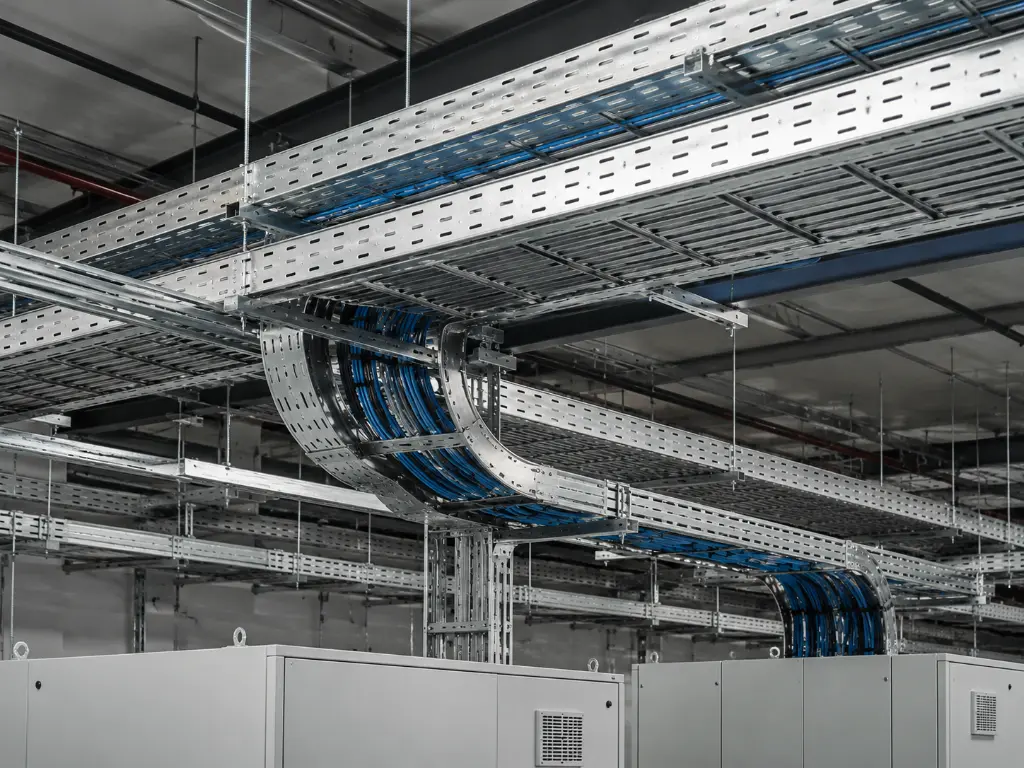
A cable tray system is a structured support system used to route and support electrical, power, control, instrumentation, and communication cables.
Instead of allowing cables to run loosely across ceilings, walls, floors, or equipment areas, a cable tray provides a defined route that keeps the installation organised.
A complete system can include straight tray sections, bends, tees, crosses, reducers, covers, couplers, brackets, supports, and other accessories required to create a continuous cable pathway.
The design of the system depends on the number and type of cables, available installation space, environmental conditions, support spacing, and future expansion requirements.
For large Saudi projects, engineers should consider the complete cable route rather than selecting tray sections individually. A well planned system reduces installation difficulties and makes future maintenance considerably easier.
Why Cable Trays Are Important for Saudi Projects
Electrical infrastructure in Saudi Arabia often operates in demanding environments. Industrial facilities may run continuously, while power distribution, control systems, and communication networks need reliable cable support throughout their service life.
A suitable cable tray system provides several practical advantages. It keeps cables organised, improves accessibility, supports better airflow around cables, and simplifies inspection.
Open tray systems can also make it easier for maintenance teams to identify individual cable routes without removing large sections of building infrastructure.
From practical experience with industrial installations, cable management problems often appear when tray capacity, support spacing, or future cable requirements were not considered during the original design.
A system that looks adequate during initial installation can become overcrowded when additional cables are added later.
For this reason, engineers should consider future capacity during the design stage.
Main Types of Cable Tray Used in Saudi Arabia
No single cable tray design is suitable for every application. The correct choice depends on the type of cables, environmental conditions, load requirements, installation location, and project specifications.
The main cable tray configurations include perforated cable trays, ladder cable trays, wire mesh cable trays, and solid bottom cable trays.
Each design manages cables differently and offers specific advantages.
Perforated Cable Tray
A perforated cable tray consists of a metal tray with regularly spaced openings along the base and sides.
The openings reduce weight and allow ventilation while maintaining a continuous supporting surface for cables.
This design is commonly used for electrical and control cable installations in commercial and industrial environments.
Perforated trays are particularly useful when cables require continuous support but engineers also want improved airflow around the cable installation.
They can also accommodate cable cleats, clamps, and other fixing accessories depending on the project requirements.
In Saudi Arabia, perforated cable trays are often considered for indoor electrical rooms, industrial buildings, commercial facilities, and other controlled environments.
For outdoor installations, the material and protective coating require careful consideration because environmental exposure can accelerate corrosion.
Ladder Cable Tray
The ladder cable tray uses two longitudinal side rails connected by regularly spaced rungs.
The open structure provides excellent ventilation and allows cables to be secured at different points along the route.
Ladder trays are particularly suitable for installations carrying heavy power cables or large quantities of cables.
The open design also makes cable installation and maintenance easier because technicians can access the cables from multiple directions.
Large industrial facilities, power related projects, manufacturing plants, and infrastructure developments can benefit from ladder cable tray systems.
When selecting a ladder tray, engineers should evaluate the total cable load, support spacing, span length, and required structural strength.
Wire Mesh Cable Tray
Wire mesh cable tray is manufactured from welded steel wire to create an open mesh structure.
It is often selected for communication, data, control, fibre optic, and lighter electrical cable installations.
The open mesh design provides excellent ventilation and allows technicians to make cable drops at convenient points without cutting large openings into a solid tray.
Wire mesh trays can also be relatively lightweight compared with heavier cable support systems, which can simplify handling during installation.
They are particularly useful in data centres, commercial buildings, communication rooms, and applications where frequent cable routing changes are expected.
For industrial environments, engineers should select a wire mesh system with appropriate wire diameter, surface protection, load capacity, and support configuration.
Solid Bottom Cable Tray
Solid bottom cable trays provide a continuous base beneath the cables.
This design can provide additional mechanical protection and can be considered when cable containment requirements call for a more enclosed support surface.
Depending on the application, solid bottom trays may be installed with covers to provide additional protection against dust, falling materials, or other environmental factors.
However, engineers should consider heat dissipation when selecting this type of system because cable operating temperature can be affected by the way cables are contained.
The final design should therefore consider the cable manufacturer's requirements and the electrical characteristics of the installation.
Cable Tray and Cable Trunking Are Not the Same
Cable tray and cable trunking serve similar cable management objectives, but their construction and applications differ.
Cable trays generally provide an open support structure that allows easier access and ventilation. Trunking usually provides a more enclosed pathway for cables.
This difference makes cable trays particularly useful for installations where ventilation, inspection, and future cable changes are important.
Trunking may be more suitable when cables require greater physical enclosure or when the project design calls for a contained pathway.
Engineers should select between the two based on the cable type, environmental conditions, installation location, maintenance requirements, and project specifications.
Choosing the Right Cable Tray Material
Material selection directly affects the performance and service life of a cable tray system.
Steel remains one of the most widely used materials for industrial cable support because it provides strong structural performance and can handle demanding cable loads.
For projects exposed to moisture or corrosive environments, protective coatings become particularly important.
Galvanized steel provides corrosion protection by applying a zinc coating to the steel surface. This makes galvanized cable trays suitable for many outdoor and industrial applications where environmental exposure is a concern.
Stainless steel can also be considered for highly corrosive environments, although the higher material cost means it should be selected based on actual project requirements.
The correct material should always reflect the environment rather than simply the initial purchase price.
Why Galvanized Cable Tray Is Important in Saudi Arabia
Environmental exposure varies considerably across the Kingdom.
A project in Riyadh may face intense heat, dust, and dry conditions, while an industrial facility in Jubail or Dammam may experience higher humidity and salt exposure.
Yanbu and other coastal locations can present similar corrosion challenges.
For these applications, galvanized cable trays can provide an important layer of corrosion protection.
The quality and specification of the galvanizing process matter. Engineers and procurement teams should evaluate the required coating specification and confirm that the selected product meets the project's technical requirements.
For particularly demanding environments, the project specification may require additional corrosion protection or a different material altogether.
Cable Tray Load Capacity
Cable tray selection should never depend only on tray dimensions.
The system must support the actual weight of the cables over the required span while maintaining structural stability.
Engineers should consider cable weight, tray width, tray depth, support spacing, installation orientation, environmental loads, and any additional loads that may affect the system.
Overloading a cable tray can lead to deformation and may compromise the installation.
A professional design should therefore calculate the expected load and select a tray system with suitable capacity.
Future expansion should also be considered. If the facility is likely to add additional power, control, or communication cables, the initial design should provide sufficient capacity for future requirements.
Contact Us
Protect your assets with Hitech Fence’s . For consultations, demonstrations, or inquiries:
Cable Tray Width and Size
Cable tray dimensions should correspond to the number, diameter, and arrangement of the cables being installed.
A tray that is too narrow can create overcrowding and make maintenance difficult. A tray that is unnecessarily large can increase material and installation costs.
The engineer should evaluate the actual cable schedule before selecting tray width.
Common project requirements may involve several tray widths, including systems suitable for small control cables as well as large industrial power cables.
The final size should always follow the approved electrical design rather than relying on a standard size for every installation.
Cable Tray Supports and Accessories
A cable tray system depends on more than the tray itself.
Supports and accessories provide the structural connection between the tray and the building or industrial structure.
Typical components include brackets, couplers, clamps, support channels, hangers, bends, tees, crosses, reducers, covers, and other fittings.
Poor quality accessories can compromise an otherwise well designed cable tray system.
Support spacing also matters. Excessive spacing can increase deflection, while inadequate spacing can increase material and installation costs.
The support arrangement should therefore follow the tray manufacturer's recommendations and the project's engineering requirements.
Cable Tray Installation in Saudi Arabia
Professional installation is essential for achieving reliable cable management.
Before installation begins, contractors should review the approved drawings and confirm the cable routes, elevations, access requirements, support locations, and interfaces with other building services.
The installation team should maintain proper alignment throughout the route and avoid unnecessary sharp changes in direction.
Cable trays should also be installed with adequate clearance from heat producing equipment and other services where required by the project design.
For outdoor installations, drainage and environmental exposure should receive particular attention.
A well installed cable tray system makes future cable pulling, inspection, repair, and expansion considerably easier.
Cable Tray for Industrial Facilities
Industrial facilities often have some of the most demanding cable management requirements.
Manufacturing plants may contain power cables, control cables, instrumentation systems, communication networks, and automation equipment operating throughout the facility.
These systems may require separate cable routes depending on the electrical and operational requirements of the project.
Larger industrial facilities may also require heavy duty tray systems capable of supporting substantial cable loads over longer spans.
The tray design should therefore be developed as part of the facility's overall electrical infrastructure rather than treated as a simple construction component.
Cable Tray for Power and Utility Projects
Power and utility projects require reliable cable support because electrical systems can operate continuously under significant loads.
Cable trays may be used for power distribution, control systems, instrumentation, and communication infrastructure.
For these projects, engineers should pay particular attention to structural capacity, cable separation, environmental exposure, earthing requirements, and accessibility.
The cable tray system should integrate properly with electrical rooms, substations, equipment areas, and outdoor cable routes.
A carefully planned system improves maintenance access and reduces the likelihood of future cable routing problems.
Cable Tray for Data Centres and Communication Facilities
Data centres have different cable management priorities.
Communication and fibre optic cables require organised routing, adequate separation, and effective airflow management.
Wire mesh cable trays are often useful in these environments because their open design provides easy access and ventilation.
The installation should also allow technicians to add or remove cables without disrupting existing systems.
For data centre projects, cable management should be planned alongside rack layouts, containment systems, cooling requirements, and future expansion.
How to Select a Cable Tray Supplier in Saudi Arabia
Selecting a cable tray supplier should involve more than comparing prices.
Project owners and contractors should evaluate manufacturing quality, material specifications, coating quality, available tray types, accessory availability, technical support, and manufacturing capacity.
A supplier with experience in Saudi industrial projects can provide practical guidance on material selection and environmental conditions.
For large projects, local availability can also be important because cable tray systems require numerous fittings and accessories during installation.
A supplier that can provide a complete system rather than only straight tray sections can simplify procurement and reduce compatibility issues during construction.
Cable Tray Manufacturer Versus Supplier
A cable tray manufacturer produces the tray system and may provide technical specifications, custom dimensions, accessories, and project specific manufacturing.
A supplier may distribute products manufactured by another company.
Both can serve a project effectively, but major industrial developments may benefit from working directly with an experienced manufacturer that can support technical requirements and large volume orders.
For Saudi projects, buyers should verify manufacturing capabilities, quality procedures, product specifications, and project experience before placing large orders.
Cable Tray Cost in Saudi Arabia
Cable tray pricing depends on several factors.
Material, tray type, dimensions, thickness, coating, quantity, accessories, support requirements, transportation, and installation can all influence the final project cost.
A perforated cable tray, ladder cable tray, and wire mesh cable tray can have significantly different prices because their manufacturing processes and structural characteristics differ.
For this reason, there is no single cable tray price that applies to every Saudi project.
The most useful approach is to prepare a cable schedule and project specification before requesting quotations.
This allows suppliers to provide a more accurate comparison based on equivalent technical requirements.
Cable Tray Standards and Project Specifications
Cable tray systems should be selected according to the standards and technical requirements specified for the project.
IEC 61537 is a commonly referenced international standard for cable tray and cable ladder systems. However, the applicable requirements can vary depending on the project, authority, consultant, electrical design, and installation environment.
Saudi industrial and infrastructure projects may also include additional specifications from the client, consultant, utility provider, or other relevant authority.
Contractors should therefore avoid selecting products based only on a general statement that a tray is compliant.
The supplier should provide appropriate technical documentation and certification where required by the project.
How Hitech Can Support Cable Tray Projects in Saudi Arabia
For industrial and infrastructure projects, cable tray selection should begin with the actual application rather than a catalogue product.
Hitech can support project requirements by evaluating the intended cable application, environmental exposure, tray configuration, required dimensions, and project quantities.
This approach is particularly useful for projects involving large industrial facilities where multiple cable tray types may be required within the same development.
A project may use ladder trays for heavy power cables, perforated trays for control systems, and wire mesh trays for communication or data cables.
Selecting each system according to its application can improve performance while avoiding unnecessary material costs.
Final Thoughts
Cable tray systems form an important part of electrical infrastructure across Saudi Arabia. They provide organised cable routing, improve maintenance access, support safer installations, and allow facilities to manage future cable expansion more effectively.
Perforated cable trays, ladder cable trays, wire mesh cable trays, and solid bottom trays each serve different requirements. The correct selection depends on cable type, load, environment, installation location, and project specifications.
Saudi Arabia's climate makes material and corrosion protection particularly important. Galvanized cable trays can provide valuable protection for many outdoor and industrial applications, while more demanding environments may require alternative materials or additional protective measures.
For project owners, consultants, electrical contractors, and procurement teams, the best cable tray system is not necessarily the cheapest option. It is the system that provides the required structural performance, environmental protection, accessibility, and long term value.
A properly designed cable tray system can support an electrical installation for many years while making future maintenance and expansion significantly easier.
For a Saudi project, the selection process should therefore consider the complete system, including trays, ladders, fittings, supports, coatings, installation requirements, and future capacity, rather than treating cable management as a simple material purchase.