Perforated cable trays provide a practical way to support and organise electrical cables in commercial, industrial, and infrastructure projects across Saudi Arabia. Their perforated base and side walls provide continuous cable support while allowing ventilation and convenient cable fixing.
As Saudi Arabia continues to expand its industrial facilities, commercial developments, data centres, warehouses, manufacturing plants, and infrastructure projects, reliable cable management has become increasingly important. Electrical installations need support systems that can handle the required cable loads while remaining accessible for inspection, maintenance, and future expansion.
Choosing a perforated cable tray involves more than selecting a standard width. Engineers and contractors need to consider cable type, load capacity, tray dimensions, material, coating, support spacing, environmental exposure, and project specifications.
This guide explains how perforated cable trays work, where they are used, how to select them, and what Saudi project owners should consider before purchasing or installing them.
What Is a Perforated Cable Tray?
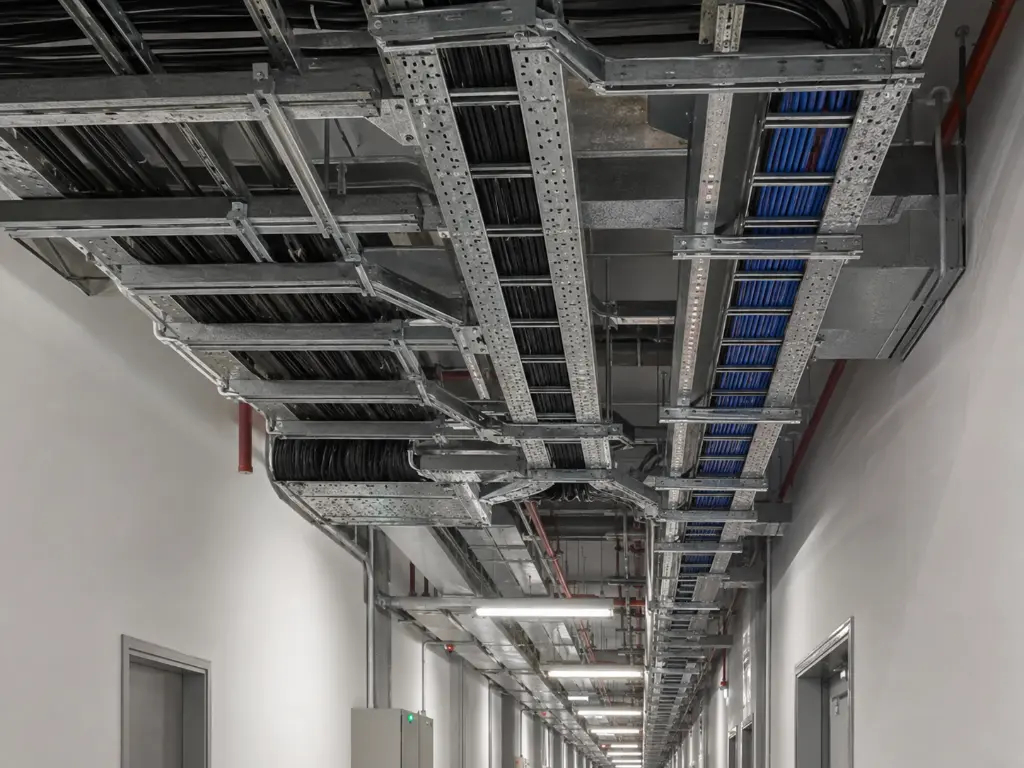
A perforated cable tray is a metal cable support system manufactured with regularly spaced openings in its base and side sections.
The perforations reduce the overall weight of the tray while maintaining a continuous surface for supporting cables. They also provide ventilation and allow installers to secure cables using suitable clamps, ties, and other accessories. Unlike ladder cable trays, which use open rungs, a perforated tray provides more continuous support beneath the cables. This makes it suitable for installations where cables need stable support across the entire route. Perforated cable trays are available in different widths, depths, thicknesses, materials, and surface finishes to meet different project requirements.
Where Are Perforated Cable Trays Used?
Perforated cable trays are used in a wide range of electrical installations. They can support power cables, control cables, instrumentation cables, and other electrical systems depending on the project design. Common applications include industrial buildings, commercial facilities, warehouses, electrical rooms, manufacturing plants, utility facilities, infrastructure developments, and large construction projects. Indoor installations often use perforated trays where environmental exposure is controlled. Outdoor installations require greater attention to material and corrosion protection because Saudi Arabia's climate can expose steel components to heat, dust, moisture, and salt.
Why Use a Perforated Cable Tray?
The design of a perforated cable tray provides several practical advantages. The continuous tray surface supports cables along their route and helps keep the installation organised. The openings provide ventilation while also allowing installers to attach cables at convenient points. Maintenance teams can easily access cables without dismantling an enclosed cable management system. The perforated structure also allows fittings and accessories to be installed more conveniently during construction. For many commercial and industrial applications, this combination of support, accessibility, ventilation, and flexibility makes perforated cable trays a practical solution.
Perforated Cable Tray for Saudi Arabia's Climate
Environmental conditions should be considered before selecting a cable tray system. Saudi Arabia experiences high temperatures and significant dust exposure across many inland areas. Coastal locations such as Jeddah, Dammam, Jubail, and Yanbu can also experience higher humidity and salt exposure. These conditions can accelerate corrosion when unprotected steel is exposed to the environment. For outdoor and demanding industrial applications, galvanized steel can provide effective corrosion protection. The appropriate coating should depend on the actual environment and project specification. A tray installed inside a controlled electrical room may have different material requirements from a tray installed outside a coastal industrial facility.
Galvanized Perforated Cable Tray
Galvanized perforated cable trays are widely considered for outdoor and industrial installations where corrosion protection is important. The zinc coating provides protection to the underlying steel and helps extend the service life of the tray. This can be particularly valuable in Saudi Arabia where cable management systems may remain exposed for many years. For coastal and industrial environments, project teams should verify the required galvanizing specification rather than simply requesting a product described as galvanized. The coating thickness, manufacturing process, and applicable project requirements should be reviewed before procurement.
Powder Coated Perforated Cable Tray
Powder coating can provide an additional protective and aesthetic finish to steel cable trays. It is often considered for indoor commercial environments, electrical rooms, offices, and installations where appearance is important. Powder coating provides a smooth finish and allows the project to use a specified colour. For outdoor installations, however, the complete coating system should be evaluated according to the environmental exposure and project requirements. In demanding environments, galvanization combined with an appropriate additional coating system may provide greater protection than powder coating alone.
Perforated Cable Tray vs Ladder Cable Tray
Perforated and ladder cable trays are both widely used, but their designs serve different purposes. A perforated tray provides a continuous support surface beneath the cables. This can be useful where smaller cables, control cables, or installations requiring continuous support are involved. A ladder cable tray consists of two side rails connected by rungs. Its open structure provides excellent ventilation and easy access from multiple directions. Ladder trays are often preferred for heavy power cables and installations requiring strong ventilation. The correct choice depends on the cable type, load, environment, installation method, and project design. Neither system should automatically be considered better than the other for every application.
Perforated Cable Tray vs Wire Mesh Cable Tray
Wire mesh cable trays are manufactured from welded steel wire and provide a highly open structure. They are particularly useful for communication, data, fibre optic, control, and lighter cable installations. Perforated trays provide a more continuous support surface and can therefore be more suitable where cables require additional support. Wire mesh systems can provide excellent ventilation and flexibility for cable routing. The decision should be based on the cable type and installation requirements rather than simply comparing the physical appearance of the two products.
Selecting the Correct Cable Tray Width
Tray width should be based on the number and size of cables that the system needs to accommodate. A narrow tray can lead to overcrowding and make future maintenance difficult. An unnecessarily wide tray can increase material costs and may require larger supports. Engineers should therefore review the cable schedule before finalising the tray width. It is also good practice to consider future cable additions. Industrial facilities frequently expand electrical systems after the initial construction phase. Leaving appropriate capacity can make future modifications significantly easier.
Contact Us
Protect your assets with Hitech Fence’s . For consultations, demonstrations, or inquiries:
Cable Tray Load Capacity
Load capacity is one of the most important technical considerations. The tray must safely support the combined weight of the cables across the required support span. Engineers should consider cable weight, tray dimensions, material thickness, support spacing, span length, installation orientation, and environmental loads. A tray that is suitable for a light control cable installation may not be suitable for a heavy power cable route. Manufacturers should provide technical information that allows engineers to evaluate the structural capacity of the selected system.
Cable Tray Thickness
Material thickness affects the structural performance of a perforated cable tray. Heavy cable loads and longer support spans may require stronger tray construction. Lighter installations may use thinner material when permitted by the project specification. Selecting the thinnest available tray simply to reduce material cost can create structural problems if the actual cable load has not been properly evaluated. For industrial projects, the tray thickness should therefore follow engineering calculations and manufacturer recommendations.
Perforated Cable Tray Accessories
A complete cable tray installation requires more than straight sections. Projects may require bends, tees, crosses, reducers, couplers, covers, brackets, supports, clamps, and other fittings. Using compatible accessories helps maintain structural continuity throughout the cable route. Accessories should also have suitable material and corrosion protection for the installation environment. For large projects, purchasing the complete system from a capable manufacturer can simplify procurement and reduce compatibility issues during installation.
Cable Tray Support Spacing
Support spacing affects both the structural performance and appearance of the installation. If supports are positioned too far apart, the tray can experience excessive deflection under load. If supports are installed unnecessarily close together, material and installation costs can increase. The correct spacing depends on the tray design, material, load, span, and manufacturer's technical recommendations. Engineers should follow the approved design and manufacturer information rather than applying one support distance to every installation.
Perforated Cable Tray Installation
Proper installation ensures that the cable tray performs as intended throughout its service life. Before installation begins, contractors should confirm cable routes, elevations, support locations, equipment interfaces, and access requirements. Tray sections should remain properly aligned and securely connected. Sharp edges or damaged protective coatings should also be addressed during installation. Outdoor routes require additional attention to environmental exposure and water management. A well installed cable tray system should provide easy access for cable installation, inspection, and future maintenance.
Perforated Cable Tray for Industrial Projects
Industrial facilities often have complex electrical requirements. A single plant may contain power distribution cables, control systems, instrumentation, automation equipment, and communication networks. Perforated cable trays can support several of these applications when the tray design and cable arrangement are suitable. The system should be coordinated with mechanical services, equipment locations, electrical rooms, and structural elements. Early coordination is important because cable tray routes can occupy significant space in industrial facilities. Poor coordination during the design stage can lead to costly changes during construction.
Perforated Cable Tray for Commercial Buildings
Commercial buildings require organised cable management for power distribution, lighting, control systems, and communication infrastructure. Perforated cable trays can provide an accessible and organised route above ceilings, inside service areas, and within electrical rooms. For commercial projects, appearance can also influence material and coating selection. Where trays remain visible, project teams may choose a finish that complements the building's design while maintaining the required technical performance.
Perforated Cable Tray for Outdoor Applications
Outdoor cable tray installations face greater environmental exposure than indoor systems. High temperatures, direct sunlight, dust, moisture, and coastal conditions can affect the long term performance of exposed steel. For this reason, outdoor cable trays should have appropriate corrosion protection. Galvanized steel is commonly considered for outdoor applications, while more aggressive environments may require enhanced protective systems or alternative materials. The project specification should determine the final material and coating requirements.
How Much Does Perforated Cable Tray Cost in Saudi Arabia?
The price of a perforated cable tray depends on several factors. Material type, tray width, depth, thickness, coating, quantity, accessories, support requirements, transportation, and installation can all affect the final cost. A small indoor electrical installation will have very different requirements from a large industrial project in a coastal environment. For accurate pricing, suppliers should receive the project specifications, required dimensions, quantities, coating requirements, and accessories list. Comparing quotations based only on price can result in different technical specifications being compared as though they were equivalent. A proper technical comparison should confirm that all suppliers are offering the same material, dimensions, thickness, coating, and accessories.
How to Choose a Perforated Cable Tray Supplier in Saudi Arabia
A reliable supplier should be able to provide more than a product catalogue. Project teams should evaluate manufacturing capability, material quality, coating specifications, product range, technical documentation, accessory availability, delivery capability, and experience with industrial projects. Local project experience can also be valuable because Saudi installations often involve challenging environmental conditions and large project quantities. For major developments, the supplier should be able to support engineers and contractors with technical information throughout the procurement and installation process.
Why Cable Tray Quality Matters
Cable trays are often installed above ceilings, inside industrial structures, or in locations that are difficult to access after construction. Replacing a poorly selected system can therefore be expensive and disruptive. High quality materials and proper installation can provide better structural performance and reduce maintenance requirements. The lowest initial price does not necessarily provide the lowest total project cost. A better approach is to evaluate the complete lifecycle of the cable tray system, including material quality, corrosion protection, installation, maintenance, and expected service life.
Final Thoughts
Perforated cable trays provide a reliable and practical method for supporting electrical cables across commercial, industrial, and infrastructure projects in Saudi Arabia. Their continuous support surface, ventilation openings, flexible fixing options, and accessibility make them suitable for a wide range of applications. However, selecting the correct system requires careful consideration of cable load, tray dimensions, material, coating, support spacing, environmental conditions, and future expansion. For Saudi projects, corrosion protection deserves particular attention, especially in outdoor and coastal environments. A properly specified and professionally installed perforated cable tray system can provide reliable cable support while making inspection, maintenance, and future expansion easier. The best cable tray is not simply the one with the lowest price. It is the one that matches the project's technical requirements, environmental conditions, cable load, and long term operational needs.