A cable tray installation is not complete with straight tray sections alone. Industrial and commercial projects require bends, tees, crosses, reducers, couplers, supports, brackets, covers, clamps, and other accessories to create a complete and reliable cable management route.
In Saudi Arabia, cable tray accessories must also withstand the environmental conditions of the installation. Projects in Riyadh may face extreme heat and dust, while coastal locations such as Jeddah, Dammam, Jubail, and Yanbu can expose metal components to humidity and salt.
Selecting compatible accessories is therefore just as important as selecting the cable tray itself. A properly designed cable tray system allows electrical contractors to install cables efficiently, maintain clear routes, and make future modifications without rebuilding the complete support system.
This guide explains the main cable tray accessories used in Saudi Arabia, their applications, material considerations, installation requirements, and how to select the right components for industrial and commercial projects.
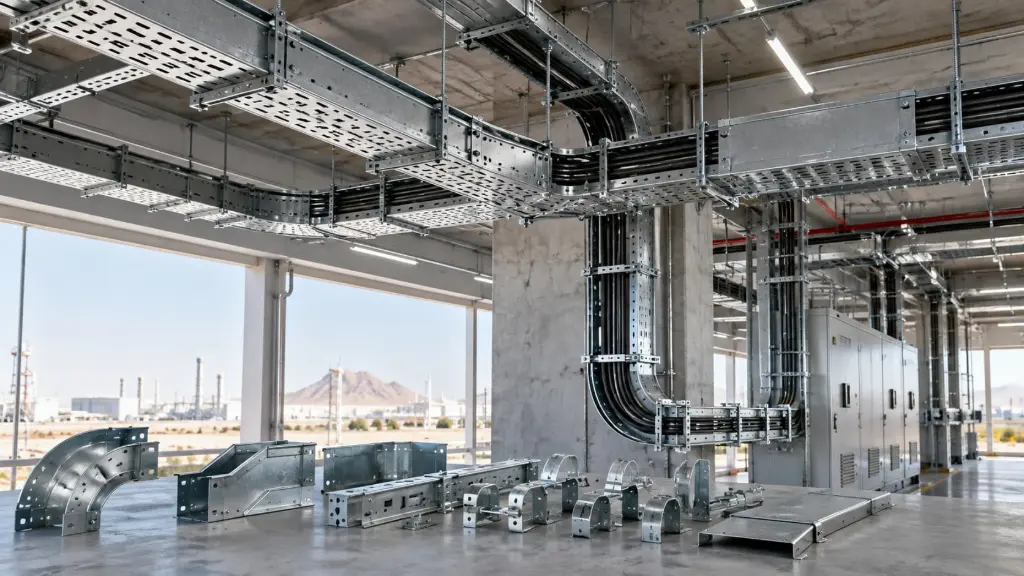
What Are Cable Tray Accessories?
Cable tray accessories are components used to connect, support, protect, change the direction, or complete a cable tray system. Straight tray sections provide the main cable route, but most real installations require the route to change direction or connect different pathways. Accessories make these changes possible while maintaining the structural and functional continuity of the cable management system.
The required accessories depend on the building layout, cable route, tray type, installation method, and project specifications. For a large industrial project, the accessory list can represent a significant part of the complete cable tray requirement.
Why Cable Tray Accessories Matter
The quality of the accessories directly affects the performance of the complete cable tray system. A strong tray connected with unsuitable couplers or poorly designed supports can create installation problems.
Accessories must carry the required mechanical load, maintain alignment, and remain compatible with the tray material and protective finish. From an installation perspective, having the correct accessories available before work begins can also prevent delays.
Contractors often face problems when the tray is delivered without the required bends, reducers, supports, or connection hardware. The installation then has to stop while additional components are sourced. For large Saudi projects, accurate accessory planning should therefore take place during the procurement stage.
Main Types of Cable Tray Accessories
Cable tray accessories vary according to the tray design and installation requirements. The most common components include bends, tees, crosses, reducers, couplers, covers, brackets, supports, clamps, and fixing hardware.
Each component performs a specific function within the cable route. Using the correct fitting allows the installation team to maintain a clean route while avoiding unnecessary cutting and modification of tray sections.
Cable Tray Bends
Cable tray bends allow the route to change direction. Horizontal bends are used when the tray needs to turn around a building structure or equipment area. Vertical bends allow the route to move between different elevations. The bend radius should be appropriate for the cable installation.
Large power cables may require sufficient bending space to prevent excessive stress on the cable during installation. This is particularly important when the cable manufacturer specifies a minimum bending radius.
Cable Tray Tees
A cable tray tee allows one main route to branch into another pathway. Tees are commonly used in large industrial facilities where electrical distribution routes need to serve multiple areas.
For example, a main cable route may run along an industrial building while separate branches feed production equipment, control rooms, electrical rooms, or other sections of the facility. Using a properly manufactured tee provides a cleaner and more reliable connection than cutting and modifying tray sections on site.
Cable Tray Crosses
Cable tray crosses allow one route to divide into multiple directions. They are useful in complex electrical installations where several cable pathways meet at a common point.
Large factories, warehouses, commercial buildings, and infrastructure facilities may require several cross connections within the same cable management network. The cross should match the dimensions and material of the connected tray sections.
Cable Tray Reducers
Reducers allow a cable tray route to transition from one width to another. For example, a main cable route may require a wider tray because it carries a large number of cables. A smaller branch route may require a narrower tray. A reducer provides a controlled transition between the two tray sizes.
The reduction should not create unnecessary cable congestion. Engineers should verify that the smaller tray still provides adequate space and load capacity for the cables entering the branch.
Cable Tray Couplers
Couplers connect individual tray sections together. A proper connection maintains the mechanical continuity of the cable tray route and helps keep adjacent sections aligned.
Couplers should be compatible with the tray design and material. For galvanized cable trays, the connection hardware should provide suitable corrosion protection. Poor quality or incompatible connection components can create weak points within the installation.
Cable Tray Covers
Covers provide additional protection over the cable tray. They can help protect cables from falling objects, dust, debris, sunlight, and other environmental exposure depending on the installation. Covers can be particularly useful in areas where mechanical protection or contamination control is required.
However, covers can affect ventilation and cable heat dissipation. Engineers should therefore evaluate the thermal requirements before covering a cable tray containing power cables.
Cable Tray Supports
Supports carry the cable tray and its cable load. Common support arrangements include wall mounted brackets, suspended supports, trapeze supports, channels, and other structural systems. The correct support depends on the building structure, tray size, cable load, installation height, and required span.
Support spacing should follow the manufacturer's technical recommendations and the approved project design. The support system should be designed together with the tray rather than selected after the tray has already been ordered.
Cable Tray Brackets
Brackets provide a connection between the tray and a wall, structure, or support framework. Wall mounted cable tray installations commonly use brackets where the building structure allows direct support. The bracket must have sufficient structural capacity for the expected tray and cable load.
The fixing method should also be suitable for the substrate. Using an undersized bracket can create excessive deflection and may affect the stability of the complete installation.
Cable Tray Clamps
Clamps help secure cables within the tray and can also be used for specific support and fixing applications. Their selection depends on cable diameter, cable weight, cable arrangement, and project requirements.
Heavy power cables may require appropriate cleats or fixing systems to control movement and maintain the required cable arrangement. Control and communication cables may use lighter fixing methods. The fixing system should always follow the electrical design and applicable requirements.
Cable Tray Accessories for Ladder Trays
Ladder cable trays require accessories that match their side rail and rung configuration. These include bends, tees, crosses, reducers, couplers, covers, supports, and fixing components.
Because ladder trays are often used for heavy power cables, the accessories should have sufficient structural capacity. The connection between the fitting and straight tray sections should maintain the required mechanical strength. For large industrial projects, engineers should verify that the complete fitting range is available before selecting a ladder tray system.
Cable Tray Accessories for Perforated Trays
Perforated cable trays use a continuous tray surface with openings. Their accessory range includes horizontal bends, vertical bends, tees, crosses, reducers, couplers, covers, supports, and brackets.
The fittings should match the tray width, depth, material thickness, and protective finish. Using properly manufactured fittings reduces the need for field modifications and helps contractors maintain consistent installation quality.
Cable Tray Accessories for Wire Mesh Trays
Wire mesh cable trays require accessories designed specifically for mesh construction. These can include connectors, bends, tees, crosses, reducers, supports, brackets, and cable fixing components. The connection method should maintain the strength and alignment of the mesh route.
Because wire mesh trays are often used for communication, control, data, and lighter electrical cables, accessibility is an important consideration. The accessory design should allow technicians to maintain the cable route without unnecessary dismantling.
Galvanized Cable Tray Accessories
Galvanized accessories provide corrosion protection for cable tray components manufactured from steel. Using a galvanized tray with unprotected steel fittings can create inconsistent corrosion protection across the system.
For outdoor and industrial installations, project teams should therefore evaluate the finish of the complete cable tray system. This includes straight sections, bends, tees, crosses, reducers, couplers, supports, brackets, covers, and connection hardware. The protective finish should match the environmental requirements of the project.
Cable Tray Accessories for Coastal Projects in Saudi Arabia
Coastal areas require additional attention to corrosion. Projects in Dammam, Jubail, Jeddah, and Yanbu can experience humid conditions and salt exposure. Cable tray accessories installed outdoors may remain exposed for many years. Selecting an appropriate corrosion resistant material or protective coating can help reduce maintenance requirements.
Project teams should consider the actual site conditions rather than applying the same coating specification to every project in Saudi Arabia. A cable tray system installed inside a controlled building environment does not necessarily require the same protection as an outdoor coastal installation.
Cable Tray Accessories for Riyadh Projects
Riyadh projects face a different set of environmental conditions. High temperatures, dust, and strong sunlight can affect exposed installations. Cable tray accessories should therefore have suitable material and surface protection for the intended location.
Industrial facilities may also have areas where heat, chemicals, or mechanical activity create additional requirements. The project specification should determine the final material and protective finish.
How to Select Cable Tray Accessories
Accessory selection should begin with the cable tray system itself. Engineers should confirm the tray type, width, depth, material, coating, cable load, route geometry, support arrangement, and environmental exposure. The accessory dimensions should match the tray dimensions.
The structural capacity should also be appropriate for the expected cable load. For complex industrial projects, it is useful to prepare a complete accessory schedule before procurement. This reduces the risk of missing components during installation.
Why Compatible Accessories Are Important
Cable tray accessories from different systems may not always fit correctly. Differences in dimensions, connection methods, material thickness, or protective finishes can create installation problems.
Using compatible accessories helps maintain alignment and structural continuity. It also reduces the need for field modifications. For large projects, purchasing a complete cable tray system from a manufacturer that can provide matching accessories can simplify procurement and installation.
Cable Tray Accessories and Future Expansion
Electrical installations often change after a facility becomes operational. New equipment may require additional power cables. Communication systems may expand. Production lines may be modified. A cable tray system with suitable spare capacity can make these changes easier.
Accessories should also be available for future branches and extensions. For example, a facility may initially require a straight cable route but later need a tee connection to supply a new production area. Planning the cable tray system for future expansion can reduce future installation costs.
Common Cable Tray Accessory Problems
One common problem occurs when contractors receive straight tray sections but not the complete accessory package. Another issue occurs when accessories do not match the tray dimensions.Improper support selection can also create excessive tray deflection.
Using unsuitable corrosion protection can become a long term problem in outdoor environments. These issues usually originate during the design and procurement stages.Preparing an accurate bill of materials and confirming accessory compatibility before delivery can prevent many installation problems.
Cable Tray Accessories and Project Procurement
Procurement teams should request complete technical information from suppliers.The quotation should clearly identify tray type, dimensions, material, coating, accessories, support components, quantities, and delivery requirements.
For large Saudi projects, procurement should also consider delivery schedules. Missing a small fitting can delay an entire cable route if the contractor cannot complete the installation. A complete accessory schedule helps the procurement team identify every required component before placing the order.
How Much Do Cable Tray Accessories Cost in Saudi Arabia?
Cable tray accessory prices vary according to the component and specification. Bends, tees, crosses, reducers, couplers, covers, supports, brackets, and clamps can all have different prices. Material, dimensions, thickness, coating, quantity, and manufacturing requirements also influence cost.
For this reason, buyers should avoid estimating the complete cable tray system based only on the price of straight tray sections. Accessories and supports can represent an important part of the overall installation cost. A complete quotation should include every component required for installation.
How to Choose a Cable Tray Supplier in Saudi Arabia
A reliable supplier should be able to provide both tray sections and compatible accessories. Project teams should evaluate manufacturing capability, material quality, protective coating, product range, technical documentation, accessory availability, production capacity, and delivery capability.
Experience with industrial and infrastructure projects in Saudi Arabia can also help suppliers understand the practical requirements of local installations. For major developments, technical support during design and procurement can help contractors avoid compatibility and installation problems.
Hitech Cable Tray Systems for Saudi Projects
Cable management requirements vary from project to project. An industrial facility may require heavy duty ladder trays for power cables, perforated trays for control systems, and wire mesh trays for communication networks. Each system requires compatible bends, tees, crosses, reducers, couplers, supports, and other components.
Hitech can support project requirements by considering the complete cable route rather than supplying isolated tray sections. This approach helps project teams select a system that matches the cable application, structural requirements, environmental conditions, and future expansion needs.
Quick Wrap Up
Cable tray accessories play an essential role in creating a complete and reliable cable management system.
Bends change the direction of cable routes. Tees and crosses create branches. Reducers connect different tray widths. Couplers connect tray sections. Covers provide additional protection, while brackets and supports provide structural stability.
For Saudi projects, environmental conditions must also influence material and coating selection. Coastal projects may require greater corrosion protection, while inland projects must consider high temperatures, dust, and outdoor exposure. The best approach is to select the complete cable tray system together with its compatible accessories.
When engineers plan the tray route, cable load, supports, fittings, protective coating, and future expansion together, contractors can install a cleaner and more reliable cable management system. For industrial and commercial projects in Saudi Arabia, proper accessory selection can improve installation efficiency, simplify maintenance, and help the cable tray system provide reliable service throughout the facility's operational life.